misterconsistency ← back to the Iconic Wall

The Iconic Wall, explained

Every equation and diagram on the wall, item by item — what it says, who found it, and why it earned its place in stone. Companion to the interactive wall; the numbering follows the legend (I–XIII around the edge, 1–10 inside the ellipse, A–J on the background). For the original wall's own scholarly key, see the Simons Center catalogue ↗.

Working draft — entries are being reviewed and rewritten one by one.

KEY TO EQUATIONS AND DIAGRAMS · I–XIII
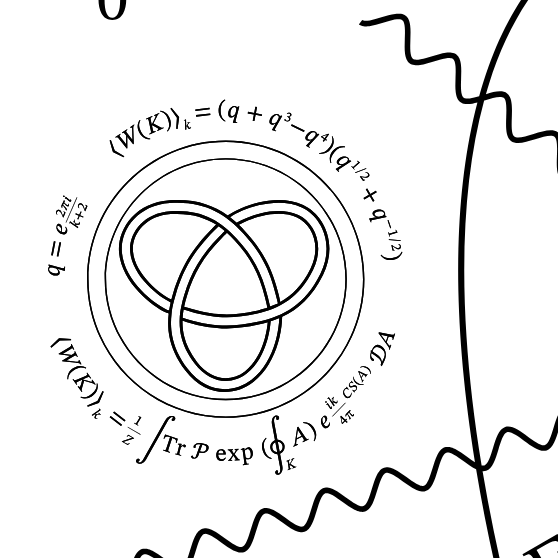
On the wall: The Jones polynomial

The Jones polynomial

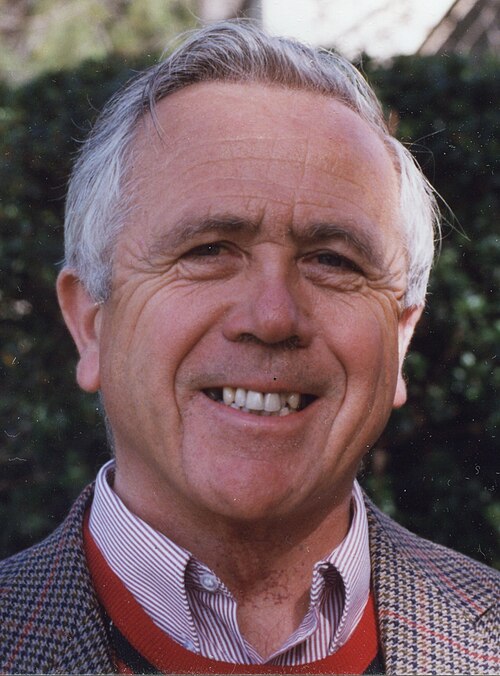
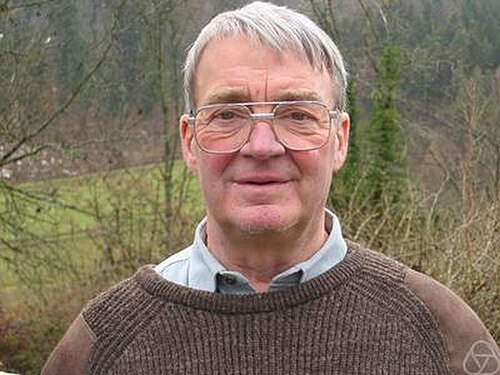
Fuse the ends of a knotted rope and no amount of pulling will ever untie it. But how do you prove that two tangles are genuinely different knots, and not the same one in disguise? For a century that question embarrassed mathematics — until 1984, when Vaughan Jones, working on something else entirely, stumbled onto a way of assigning every knot an algebraic fingerprint. Different fingerprint, different knot. Guaranteed.

The medallion shows the trefoil — the simplest true knot, the one in your shoelaces before you make the bow — wrapped in the formulas that compute its fingerprint. A few years later Edward Witten showed the polynomial falls naturally out of quantum field theory, revealing that the mathematics of knots and the mathematics of particles had been the same subject all along. Nobody had planned that. It is the wall's favorite kind of story.
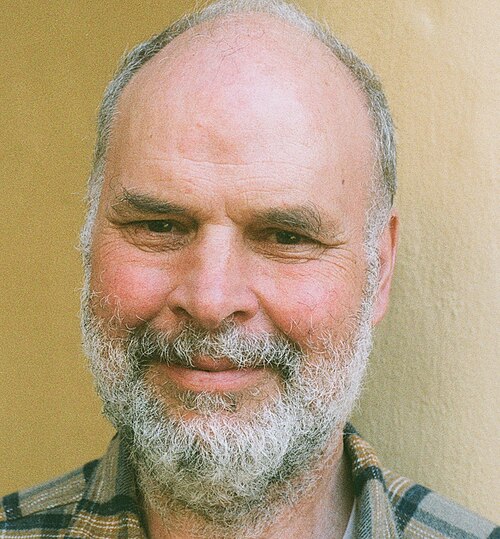
Vaughan Jones
Vaughan Jones
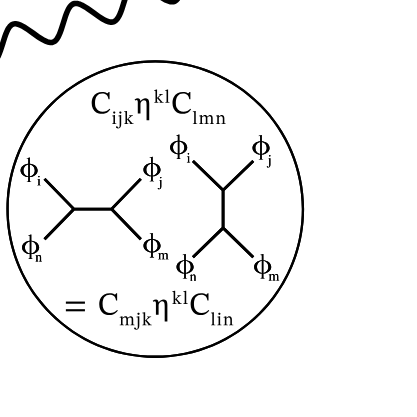
On the wall: Associativity in quantum field theory

Associativity in quantum field theory

You learned the rule in grade school without being told its name: (2 + 3) + 4 gives the same answer as 2 + (3 + 4). Grouping doesn't matter. Associativity feels too obvious to be interesting — until you ask whether the universe obeys it.

In quantum field theory, particles fuse and split. The branching diagrams in this medallion are the physicist's version of that grade-school rule: fuse three particles this way or that way, and the result must agree. What looks like simple bookkeeping is actually a harsh constraint — whole candidate theories of physics die if they fail it. The universe, it turns out, checks its arithmetic.

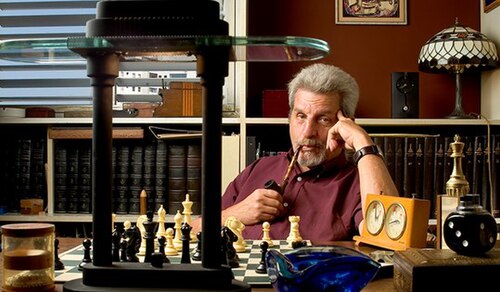
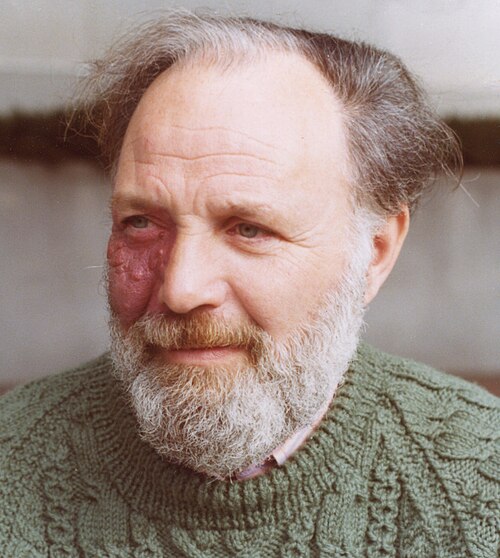
Nikita Nekrasov
Nikita Nekrasov
On the wall: The Yang–Baxter equation

The Yang–Baxter equation

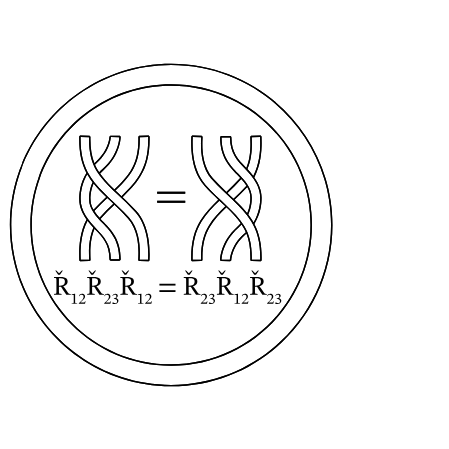
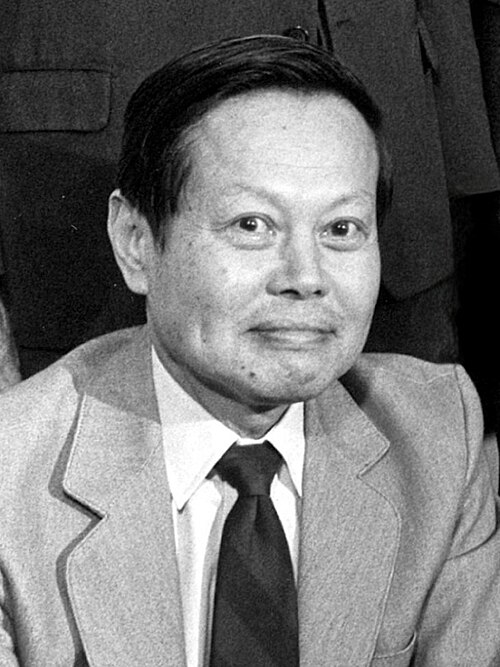
Braid three strands of hair and you create a sequence of crossings — left over middle, middle over right. The Yang–Baxter equation is the algebra of those crossings: it says certain rearrangements of who-crosses-whom change nothing at all, and it writes that fact down precisely.

It sounds like a rule for hairdressers. It turned out to be a master key. The same equation governs particles scattering in one dimension, magnets that can be solved exactly, and the braiding of exotic quantum states that may one day make quantum computers immune to noise. Whenever things swap places without losing their identity, this equation is running the show.

C. N. Yang
C. N. Yang
Rodney Baxter
Rodney Baxter
On the wall: The Lorenz attractor

The Lorenz attractor

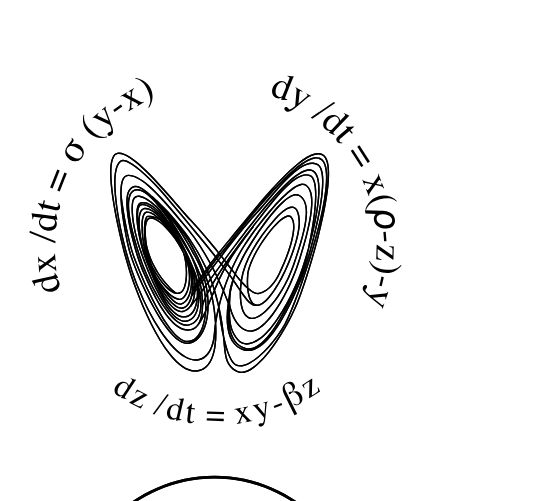
In 1963 the meteorologist Edward Lorenz re-ran a weather simulation from a saved printout, rounding 0.506127 to 0.506. The two forecasts agreed for a while — then diverged into completely different weather. Nothing was wrong with his computer. Something was wrong with the dream of prediction itself.

The butterfly-shaped curve in the medallion traces his three little equations forever: the path never repeats, never crosses itself, and never leaves the butterfly. That is deterministic chaos — a system with no randomness anywhere that is nonetheless unpredictable in practice, because infinitesimal differences grow without mercy. It is why the weather report ends at ten days, and always will.

Edward Lorenz
Edward Lorenz
On the wall: The Schwarzschild black hole

The Schwarzschild black hole

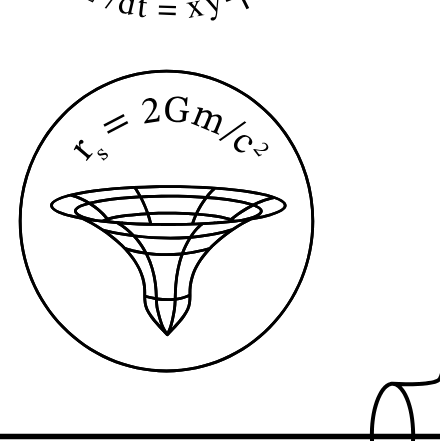
Weeks after Einstein published general relativity, a German astronomer serving on the Russian front solved its equations exactly — by hand, between artillery calculations. Karl Schwarzschild mailed the solution to Einstein, who was astonished anyone had managed it. Within a year Schwarzschild was dead of disease contracted at the front; his solution turned out to describe the strangest object in physics.

The funnel in the medallion is the shape of space around his solution, and the formula rₛ = 2Gm/c² marks the funnel's throat: the radius at which escape would require moving faster than light. Cross it and every path leads inward. We now photograph these objects at the centers of galaxies. Schwarzschild computed one in the mud, in a war, in weeks.

Karl Schwarzschild
Karl Schwarzschild
On the wall: The five Platonic solids

The five Platonic solids

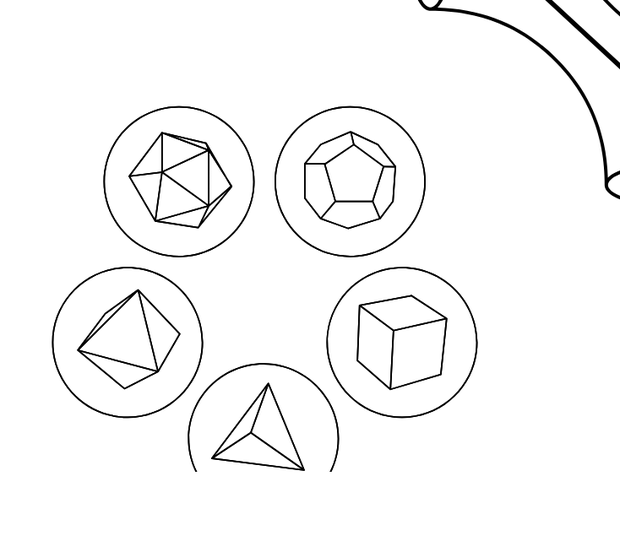
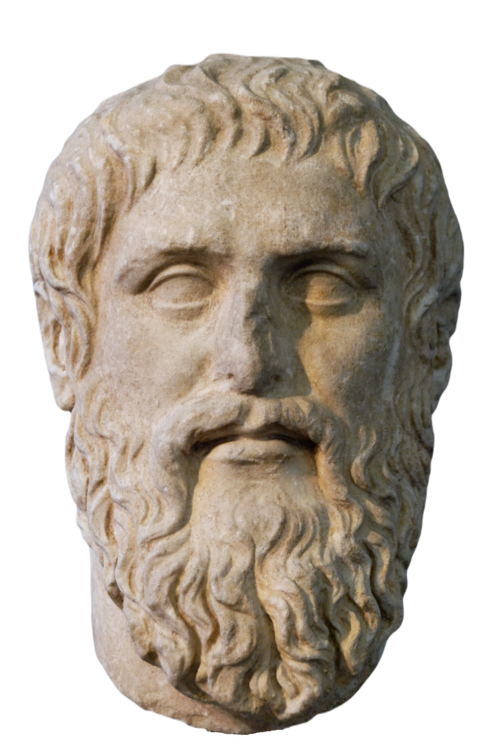
You can draw a regular polygon with any number of sides you like — three, seven, a thousand. So it seems obvious that perfectly regular solids should come in endless variety too. They don't. There are exactly five, and there will never be a sixth: tetrahedron, cube, octahedron, dodecahedron, icosahedron.

The proof is simple enough to sketch on a napkin — at every corner the meeting faces must leave a gap to fold into 3D, and only five combinations manage it. Euclid chose this as the finale of the Elements two thousand years ago. Nature got the memo: viruses build icosahedral shells, crystals stack cubes, and the five solids keep turning up wherever geometry meets matter.

Plato
Plato
On the wall: The golden ratio

The golden ratio

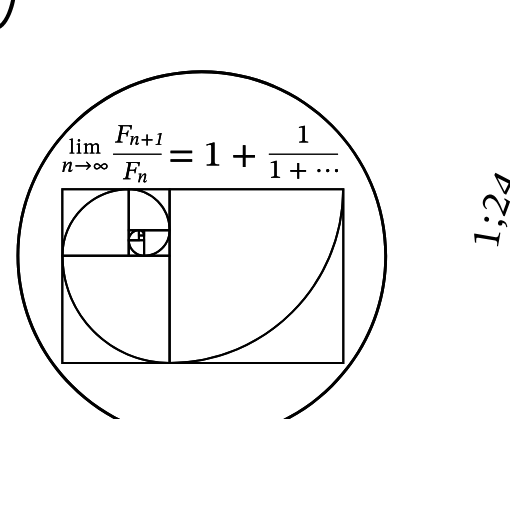
Cut a line in two so that the whole relates to the long piece exactly as the long piece relates to the short one. That single demand — proportion echoing itself — has only one answer: φ = 1.6180339…, the golden ratio.

The medallion shows its two most famous portraits: the golden rectangle that contains a smaller copy of itself forever, and the formula revealing φ as the limit of the Fibonacci numbers — 1, 1, 2, 3, 5, 8, 13, each divided by the last, marching inexorably toward it. φ is also, in a precise sense, the most irrational of all numbers, the hardest to approximate by fractions — which is exactly why sunflowers and pinecones use it to pack seeds without overlap.

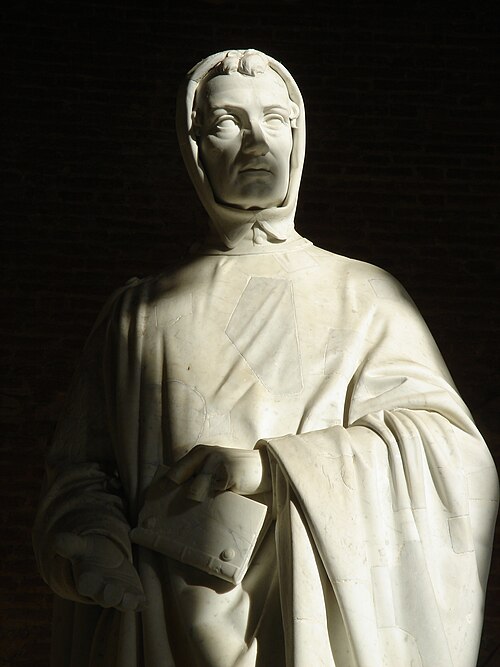
Fibonacci
Fibonacci
On the wall: The Babylonian tablet YBC 7289

The Babylonian tablet YBC 7289

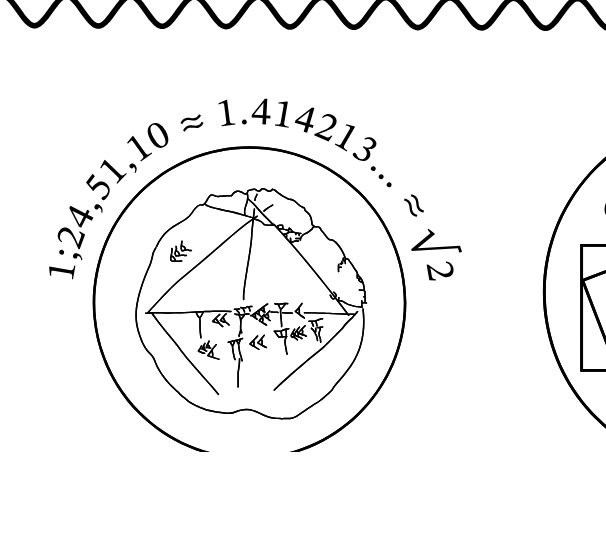
Nearly four thousand years ago — a millennium before Pythagoras — a student in Mesopotamia pressed a school exercise into wet clay: a square, its diagonal, and along the diagonal a number. Translated from base sixty, the number is 1.41421296…

The true value of √2 is 1.41421356… The clay is correct to six decimal places. The tablet, cataloged as YBC 7289 in Yale's collection, is the oldest surviving high-precision computation on Earth — proof that the hunger to calculate beautifully is older than the alphabet. The wall reproduces it as line art: homework that outlived every empire its author ever heard of.

On the wall: The Pythagorean theorem

The Pythagorean theorem

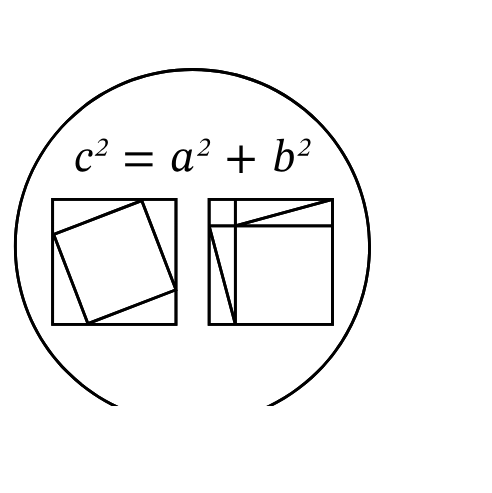
It is the one theorem everyone meets: the square on the long side of a right triangle equals the two smaller squares combined, c² = a² + b². It is also the most re-proved statement in mathematics — hundreds of distinct proofs, including one by a U.S. president.

The medallion shows a proof that needs no words at all: the same four triangles rearranged inside the same square two different ways, leaving as leftover space first the one big square, then the two small ones. Look at it long enough and the theorem stops being a formula you memorized and becomes something you have personally seen to be true — which is the entire point of proof.

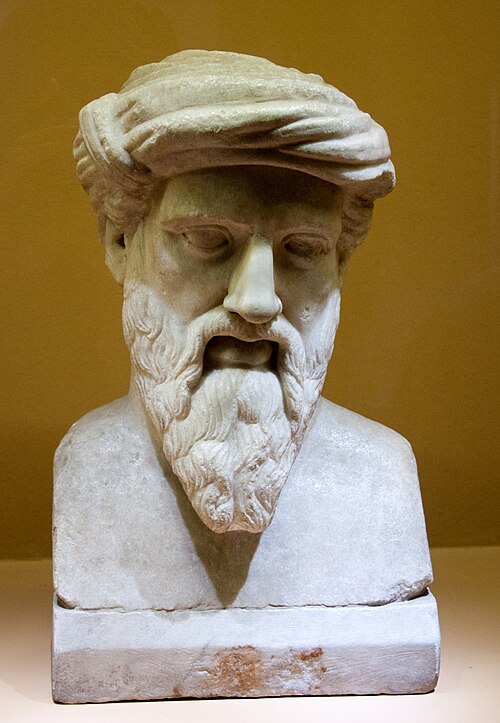
Pythagoras
Pythagoras
On the wall: The Gauss–Bonnet theorem

The Gauss–Bonnet theorem

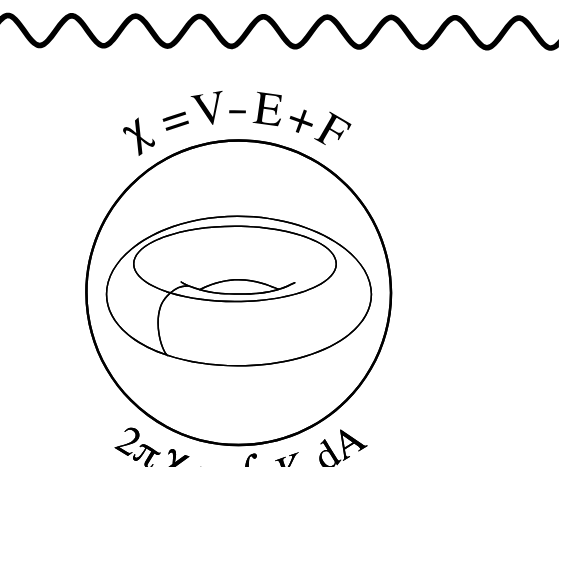
Take any surface — a sphere, a dented sphere, a sphere run over by a truck — and add up its curvature over every point. The answer is always 4π. Dent it, stretch it, crumple it: every extra bulge of positive curvature is exactly canceled by the valleys around it. The total is rigged in advance.

Rigged by what? By the only thing denting can't change: the number of holes. The formula 2πχ = ∫ K dA says total curvature is fixed by topology — and for a donut, whose χ is zero, all curvature must cancel to nothing. Local geometry is free; the global account always balances. This little identity is the ancestor of half of modern geometry, including entry 8 in the ellipse.

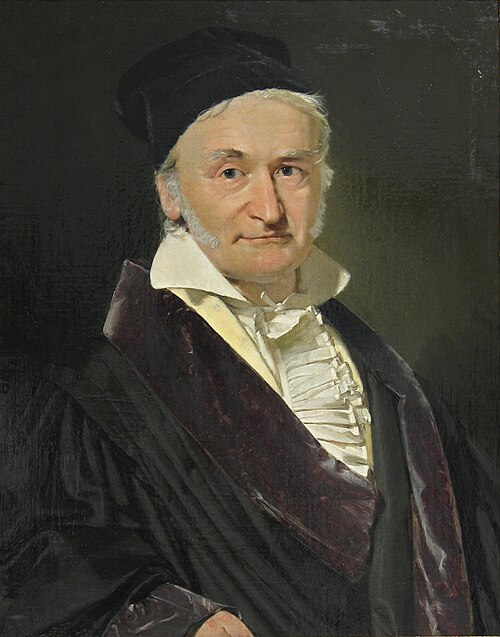
Carl Friedrich Gauss
Pierre Ossian Bonnet
On the wall: Archimedes’ sphere and cylinder

Archimedes' sphere and cylinder

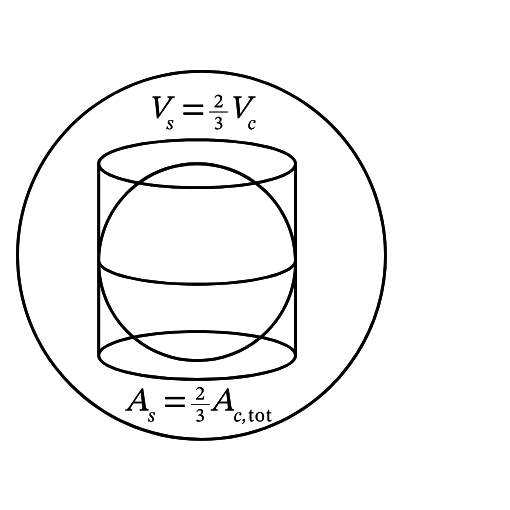
Put a ball snugly inside a can, and the ball takes up exactly two-thirds of the can's volume — and, more astonishing still, its surface is exactly two-thirds of the can's total surface. The same fraction, twice, for no obvious reason. Archimedes proved it around 225 BC and considered it the finest thing he had ever done.

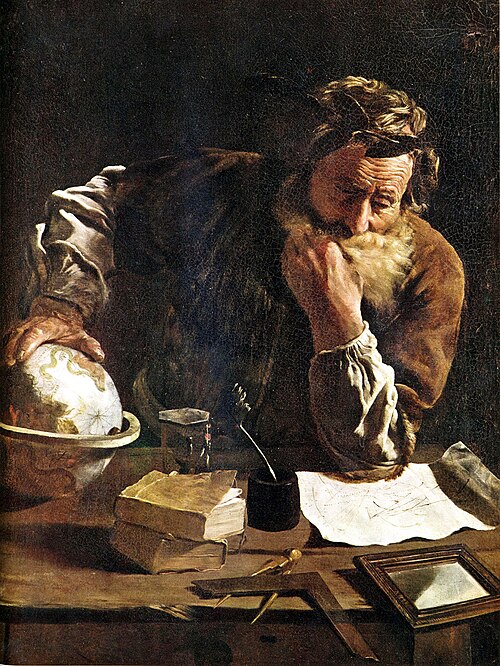
We know he did, because he asked for the figure to be carved on his tombstone. A hundred and forty years later Cicero, posted to Sicily, found the neglected grave by searching for the sphere and the cylinder. The wall repeats the gesture: a mathematician's proudest theorem, carved in stone, waiting to be recognized.

Archimedes
Archimedes
On the wall: The Aharonov–Bohm effect

The Aharonov–Bohm effect

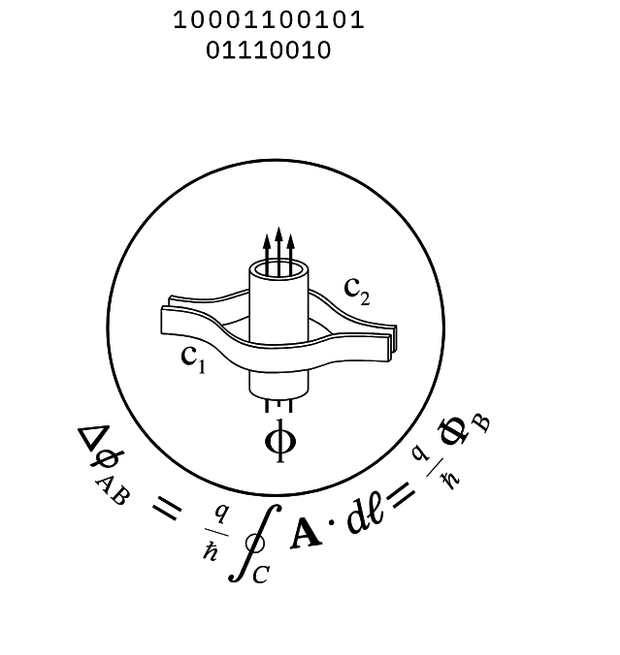
Send an electron past a magnetic coil so well shielded that the magnetic field where the electron travels is exactly zero. Classical physics says the electron cannot possibly care that the coil is there. It cares. Its quantum wave arrives measurably shifted — by an amount set by magnetic flux it never touched.

The 1959 effect proves that the electromagnetic potential — long dismissed as a bookkeeping convenience behind the "real" field — is itself physically real. What quantum particles respond to is not the local push and pull but a kind of accumulated geometric memory of the path they took. Physics keeps its books in a stranger currency than force.

Yakir Aharonov
Yakir Aharonov
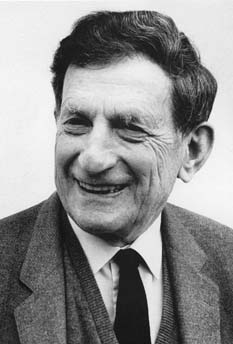
David Bohm
David Bohm
On the wall: The Navier–Stokes equations

The Navier–Stokes equations

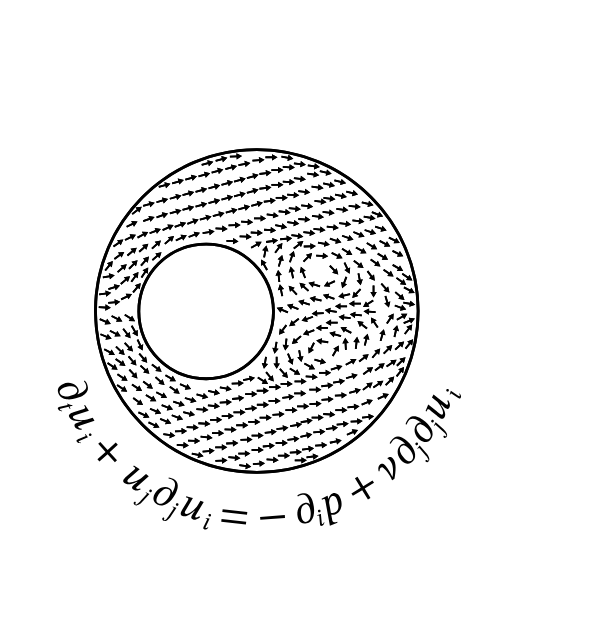
The swirl of cream in your coffee, the drag on a jetliner, the Gulf Stream, the smoke curling off a match — every fluid on Earth obeys one set of equations written down in the 1820s. Engineers solve them numerically a billion times a day.

And yet: nobody has ever proved that their solutions must always exist and behave — that the mathematics can't silently blow up to infinity in finite time. That question is one of the seven Millennium Prize Problems, with a million dollars waiting. The medallion's tidy vortex is the wall's quietest joke: the most useful equations in engineering, and among the least understood in mathematics.

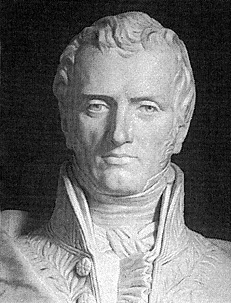
Claude-Louis Navier
Claude-Louis Navier
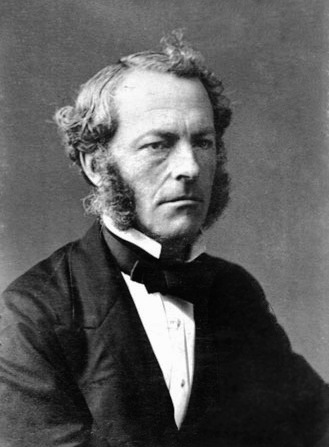
George Stokes
George Stokes
WITHIN THE ELLIPSE · 1–10
On the wall: Kepler’s 1st law — the star, the ellipse & the planet

Kepler's 1st law — the star, the ellipse & the planet

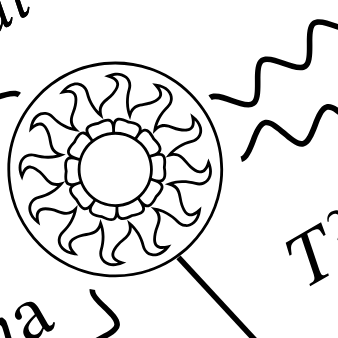
The wall's great ellipse isn't a frame — it's a diagram. The sunburst near the top is a star sitting at one focus; the small circle on the rim is a planet in orbit. That is Kepler's first law: planets travel ellipses, with the sun off-center at a focus.

It sounds mild. In 1609 it was heresy against two thousand years of instinct — from Aristotle to Copernicus, everyone had insisted the heavens must move in perfect circles, patching failure after failure with circles riding on circles. Kepler, trusting Tycho Brahe's data over the aesthetics of perfection, let the orbit be the shape it actually was. Modern science begins about there — and this wall hangs all of physics inside the shape that started it.

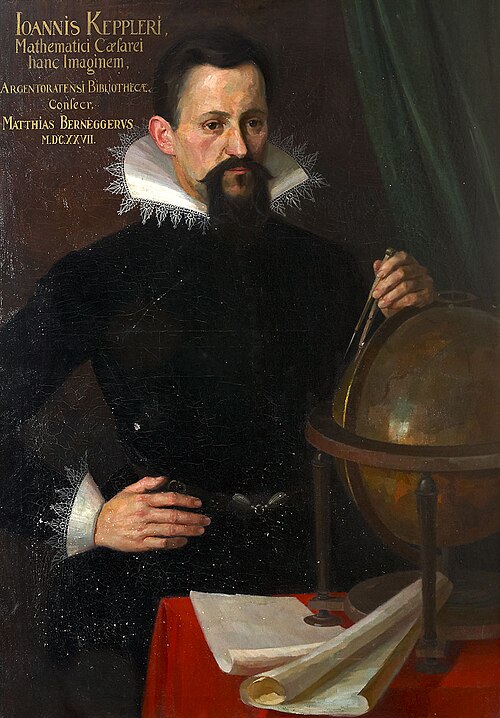
Johannes Kepler
Johannes Kepler
On the wall: Kepler’s 2nd law

Kepler's 2nd law

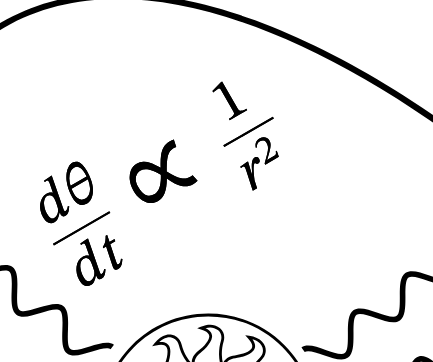
A planet does not cruise at constant speed. It tears along when close to the sun and dawdles when far away — and it does so with exact bookkeeping: the line from sun to planet sweeps out equal areas in equal times, every orbit, forever. The wall writes the law in its compact form, dθ/dt ∝ 1/r².

Kepler found the rule by grinding through Tycho's Mars data; only later would it be recognized as conservation of angular momentum — the same law that speeds a figure skater's spin when she pulls in her arms. The skater and the planet are executing the same physics.

Johannes Kepler
Johannes Kepler
On the wall: Newton’s 2nd law of motion

Newton's 2nd law of motion

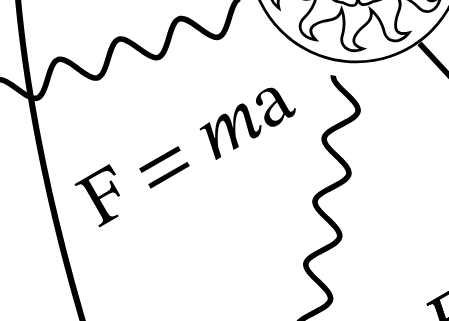
F = ma may be the most consequential three symbols ever written. Push on something, and it accelerates in proportion to the push and in inverse proportion to its heft. That's all it says.

What it did was make the future computable. Given the forces on a thing and its state right now, the law dictates where it will be next — and from that single idea flows every trajectory ever calculated: cannonballs, planets, bridges, spacecraft. Physics stopped describing motion and started predicting it, and it has never stopped.

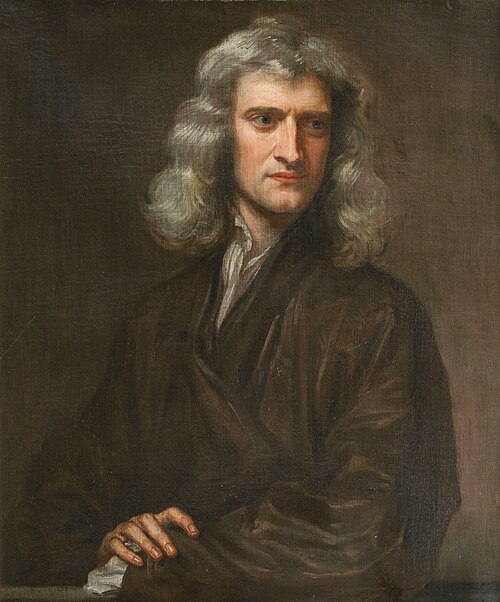
Isaac Newton
Isaac Newton
On the wall: Kepler’s 3rd law

Kepler's 3rd law

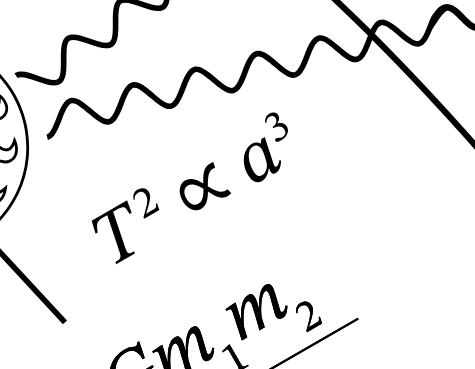
Mercury's year is 88 days; Neptune's is 165 of ours. Chaos? No — hidden order: square any planet's year and cube its distance from the sun, and the two answers stand in the same fixed ratio for every planet in the sky. T² ∝ a³.

Kepler called it the Harmonic Law and heard the music of the spheres in it. Newton heard something else: working backward from this exact proportion, he showed the sun's pull must weaken precisely as the square of distance — the crucial clue for the law of gravitation two entries below. The harmony was real; it was the sound of an inverse square.

Johannes Kepler
Johannes Kepler
On the wall: Newton’s law of gravitation

Newton's law of gravitation

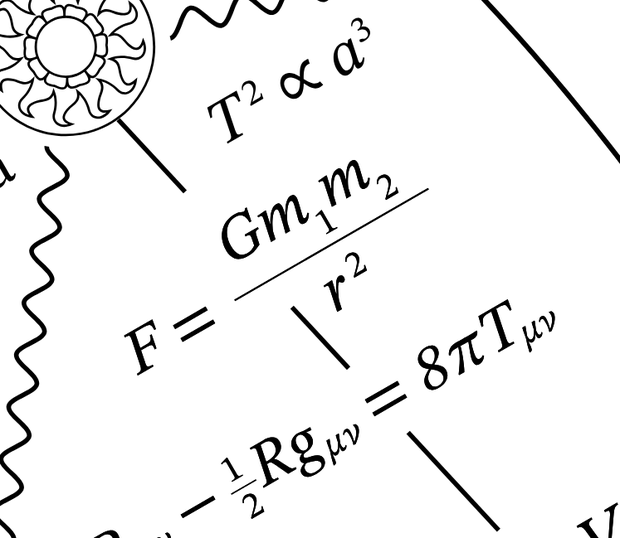
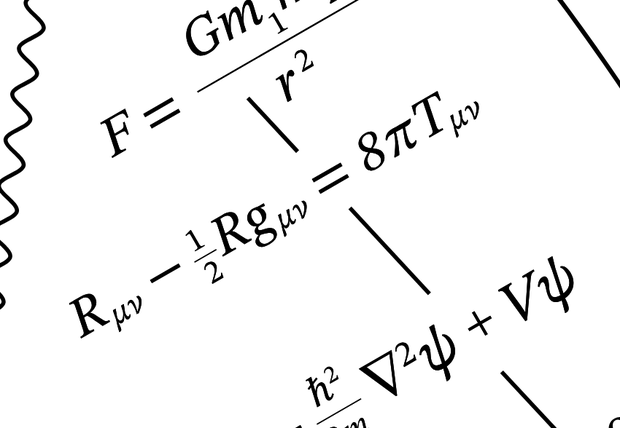
The scandal of 1687 was one word: universal. The force that drops an apple, Newton claimed, is the very force that holds the Moon — every mass pulling every other mass, across empty space, by one rule: F = Gm₁m₂/r².

Heaven and Earth had always been separate departments with separate physics. Newton merged them with a single equation — the first great unification, and the template for every one since. When physicists today dream of unifying all forces, they are trying to do again what this line did first.

Isaac Newton
Isaac Newton
On the wall: General relativity

General relativity

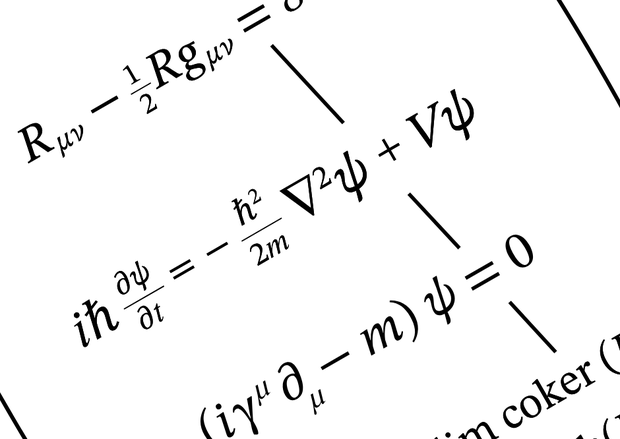
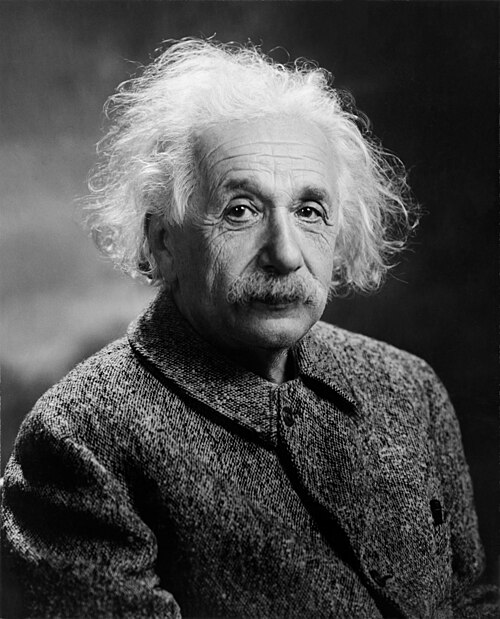
Gravity, said Einstein in 1915, is not a force reaching across space. It is the shape of space. Mass tells spacetime how to curve; curved spacetime tells mass how to move — and the field equations, Rₖₙ − ½Rgₖₙ = 8πTₖₙ, are that sentence in mathematics: matter on the right, geometry on the left.

The planet in Kepler's ellipse isn't being pulled off a straight path; it is traveling the straightest line available in a valley the sun has pressed into spacetime. The same equations predicted black holes, gravitational waves, and the expanding universe — each confirmed decades later. GPS corrects for the curvature daily. The wall's most audacious idea is also among its best tested.

Albert Einstein
Albert Einstein
On the wall: Schrödinger’s equation

Schrödinger's equation

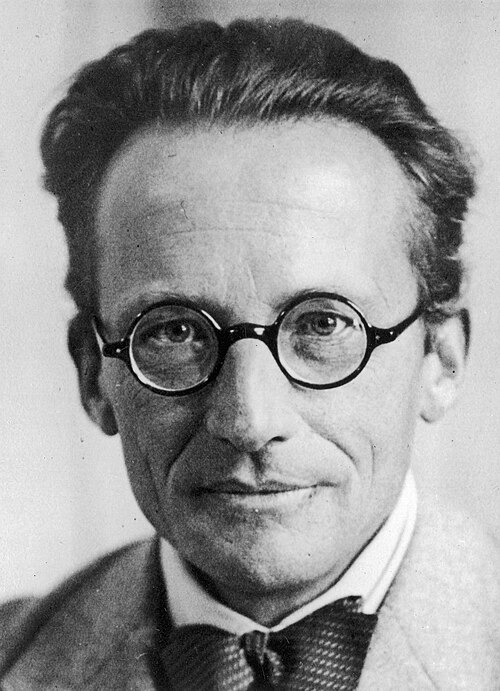
Why doesn't the electron crash into the nucleus? Why do atoms come in discrete flavors with discrete colors? Because matter, at bottom, is a wave — and Schrödinger's equation, written over Christmas 1925, is the law of how those waves ripple and settle.

An electron bound in an atom is a standing wave, like a guitar string that can only ring at certain pitches — those pitches are the energy levels, and their spacing is why neon glows red and sodium lamps glow orange. The ψ in the equation carries probabilities rather than certainties, a philosophical earthquake physics still argues about. Chemistry, meanwhile, simply is this equation, applied patiently.

Erwin Schrödinger
Erwin Schrödinger
On the wall: The Dirac equation

The Dirac equation

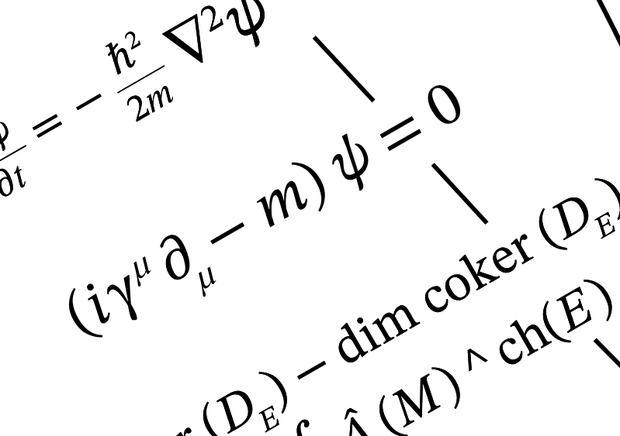
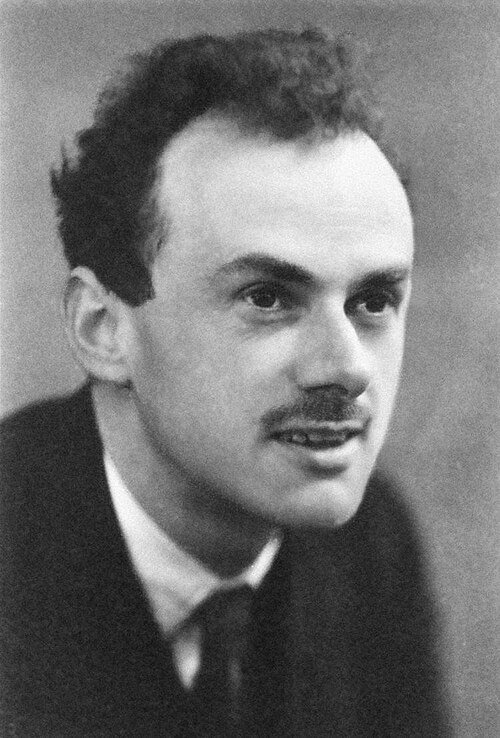
In 1928 Paul Dirac went hunting for an equation that would obey quantum mechanics and special relativity at once — and the equation he found, (iγ^μ∂ₖ − m)ψ = 0, knew more physics than he did.

Unasked, it produced the electron's spin, which had been a puzzling experimental fact. Worse, it stubbornly insisted on a second set of solutions with opposite charge. Rather than discard them, Dirac predicted a new kind of matter — and four years later the positron turned up in a cloud chamber, exactly as billed. Antimatter was discovered not in an experiment but in an equation. It remains the cleanest case of mathematics knowing something before we did.

Paul Dirac
Paul Dirac
On the wall: The Atiyah–Singer index theorem

The Atiyah–Singer index theorem

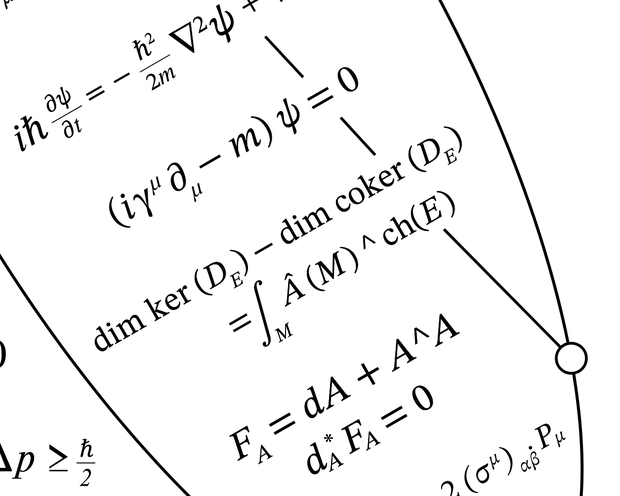
Here is a strange promise: I can tell you how many solutions a differential equation has — without solving it — just by knowing the shape of the space it lives on. That promise is the Atiyah–Singer index theorem, proved in 1963, and many mathematicians would name it the theorem of the twentieth century.

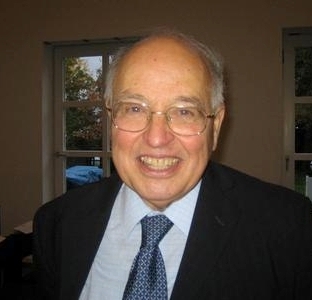
Its two sides come from different worlds: the left counts solutions (analysis, the fine-grained study of change), the right measures topology (the coarse study of holes and twists). The theorem says the two bookkeepings always agree — geometry constrains what equations can do. It has since become load-bearing in physics, where the "solutions" are particles and the "shape" is spacetime itself. On a wall full of bridges between worlds, this is the grandest span.

Michael Atiyah
Michael Atiyah
Isadore Singer
Isadore Singer
On the wall: The Yang–Mills equations

The Yang–Mills equations

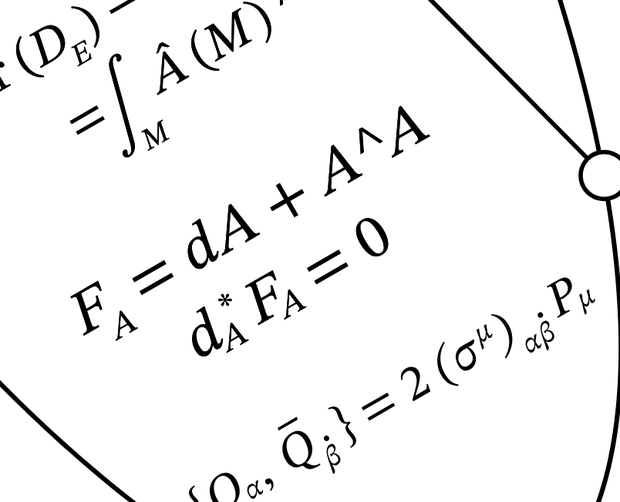
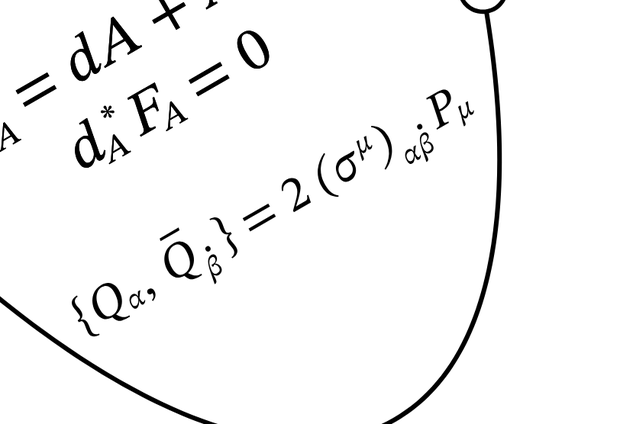
Maxwell's equations describe light: a field whose quanta — photons — don't feel each other. In 1954 Yang and Mills asked what happens if the field's own quanta carry the very charge they transmit. The answer, Fₐ = dA + A∧A with dₐ*Fₐ = 0, is Maxwell plus one self-interaction term — and that one term changes everything.

Self-interacting fields turn out to be the grammar of the strong and weak nuclear forces; the entire Standard Model of particle physics is written in Yang–Mills language. And the mathematics is so deep that proving these equations behave — the "mass gap" problem — is another of the seven Millennium Prizes. The wall thus carries two million-dollar questions, this one and XIII.

C. N. Yang
C. N. Yang
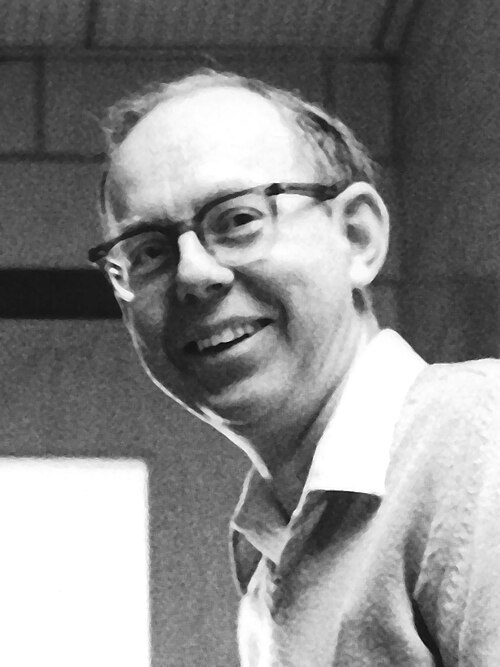
Robert Mills
Robert Mills
On the wall: Supersymmetry

Supersymmetry

Every particle in nature is either matter (like electrons) or force (like photons) — two castes that never trade places. Supersymmetry is the conjecture that the universe, at bottom, doesn't respect the caste system: every matter particle has a force-like twin and vice versa, and the anticommutator on the wall, {Qₐ, Q̄} = 2(σ^μ)Pₖ, is the exchange rule.

Its strangest clause: perform the matter–force swap twice and you don't return home — you arrive displaced in spacetime. A symmetry of particles secretly contains motion itself, which is why supersymmetry is the gateway to supergravity (entry D) and string theory. No superpartner has yet shown up in any collider. The wall keeps it anyway: the boldest guess standing.
Julius Wess
Julius Wess
ON THE BACKGROUND · A–J
On the wall: Einstein’s rest mass–energy equivalence

Einstein's rest mass–energy equivalence

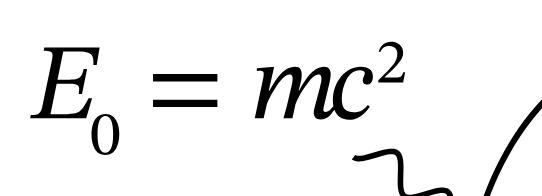
The wall writes it with a subscript most posters omit: E₀ = mc² — the rest energy. The point isn't that mass can be converted into energy. It's stronger: mass simply is energy, sitting still. Every object is a frozen reservoir.

The exchange rate, c², is astronomical: the mass of a raisin, fully liberated, is roughly a large city's day of electricity. Stars run on this arithmetic, converting millions of tons of mass to light every second; nuclear reactors sip from it. The equation fell out of special relativity in 1905 almost as an afterthought — three pages, no fanfare, the most famous formula on Earth.

Albert Einstein
Albert Einstein
On the wall: Maxwell’s equations

Maxwell's equations

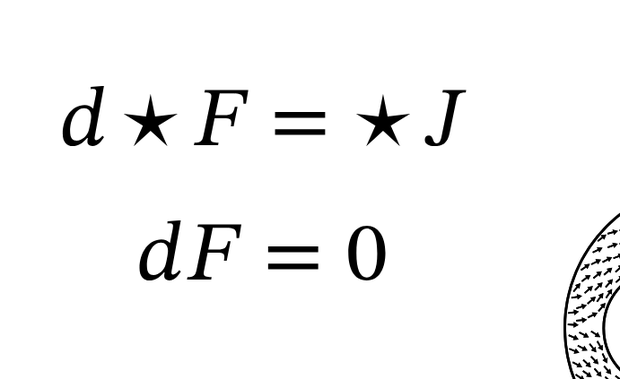
All of electricity, all of magnetism, and light itself, in two short lines: dF = 0 and d⋆F = ⋆J. When Maxwell first captured these laws in the 1860s they filled twenty equations; vector calculus later compressed them to the famous four; the modern language of differential forms — the same d and ⋆ that appear elsewhere on this wall — folds them into two. Physics got deeper by getting shorter.

Their greatest moment came from asking what the equations do in empty space: they support self-sustaining waves — electricity and magnetism regenerating each other — traveling at a speed the equations themselves compute. The speed came out as the measured speed of light. Light is electromagnetism; radio, X-rays, and the signal reaching your phone right now are the same wave at different tempos. This is the original unification the ellipse's dreamers keep trying to repeat. (Updated in the 2026 refresh: the original wall carved the four vector-calculus equations; this wall recasts them in differential forms.)

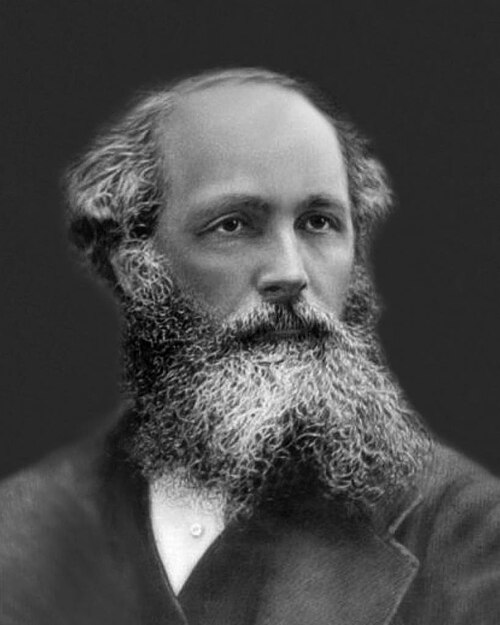
James Clerk Maxwell
James Clerk Maxwell
On the wall: Stokes’ theorem

Stokes' theorem

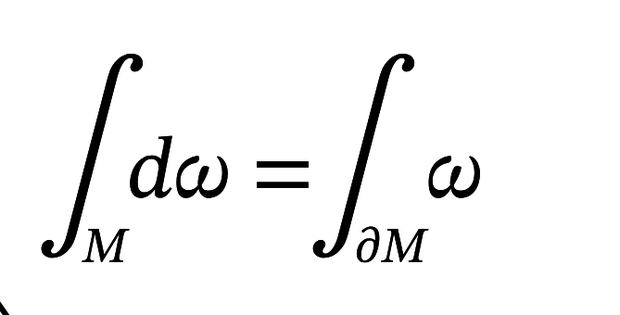
∫ₘ dω = ∫∂ₘ ω — what happens throughout a region is fully recorded on its edge. Add up a quantity's variation over an entire surface, and the answer equals a simpler tally around the boundary alone. The interior can be as complicated as it likes; the edge remembers everything.

Every "flux" and "circulation" law of physics — several of them elsewhere on this wall — is a costume worn by this one identity. It is also the fundamental theorem of calculus all grown up: there, the "region" is an interval and the "boundary" is its two endpoints. One pattern, from freshman calculus to the frontier of geometry — the wall's quiet workhorse.

George Stokes
George Stokes
On the wall: Minimal supergravity Lagrangian

Minimal supergravity Lagrangian

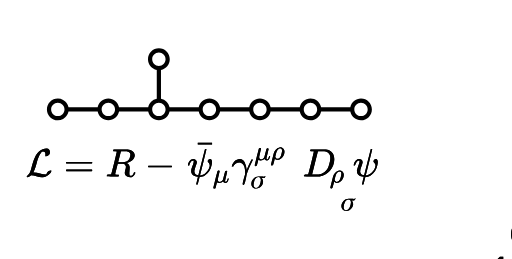
Take supersymmetry (entry 10) and insist the matter–force swap can be done differently at every point in space. That single demand forces something remarkable into existence: gravity. The symmetry cannot hold locally unless spacetime itself joins the game — Einstein's theory emerges rather than being assumed.

The Lagrangian on the wall is the minimal version: Einstein's curvature term plus its supersymmetric partner, the gravitino field. The small chain of circles beside it is a Dynkin diagram, the compressed notation mathematicians use for the symmetry underneath. Supergravity was physics' first credible sketch of quantum gravity, and it survives inside string theory today — a reminder that sometimes you don't add gravity to a theory; you ask for enough symmetry, and gravity walks in on its own.

On the wall: The boundary of a boundary is zero

The boundary of a boundary is zero

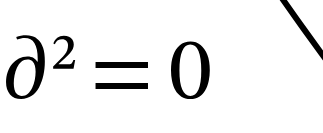
A disk's boundary is a circle. And the circle's own boundary? Nothing — a loop has no endpoints. The pattern is universal: take the edge of anything, and the edge of that edge is empty. ∂² = 0, the tersest equation on the wall.

John Wheeler liked to say that much of physics unfolds from this near-tautology. He wasn't exaggerating: the identity underwrites the conservation laws of electromagnetism, the machinery topologists use to count holes, and — written as d² = 0 — the first of Maxwell's two equations just above. Twice nothing isn't nothing here; it is one of the deepest organizing facts we possess.

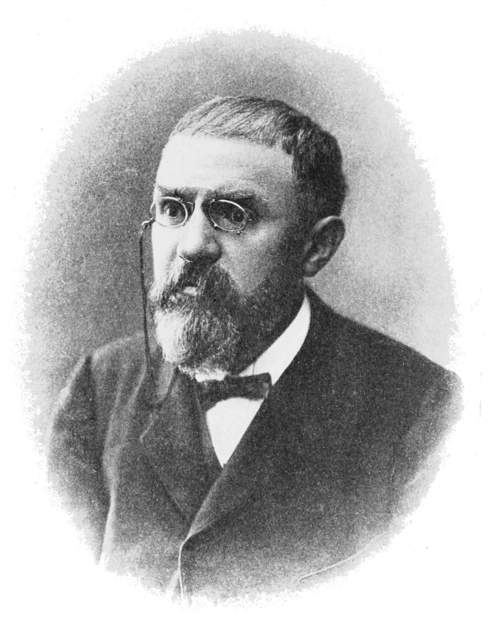
Henri Poincaré
Henri Poincaré
On the wall: Heisenberg’s uncertainty principle

Heisenberg's uncertainty principle

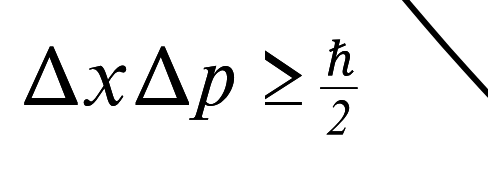
Δx·Δp ≥ ħ/2: the more precisely a particle's position is pinned down, the less precisely its momentum can even be defined — not because our instruments are clumsy, but because sharp values of both do not simultaneously exist. The fuzziness is in the world, not the ruler.

It follows directly from matter being a wave (entry 6): a wave squeezed into a tiny region must be built from many wavelengths, and wavelength is momentum. The principle is why atoms don't collapse — confining an electron too tightly makes its momentum explode — so the floor under your feet is being held up, right now, by the refusal of reality to sit perfectly still.

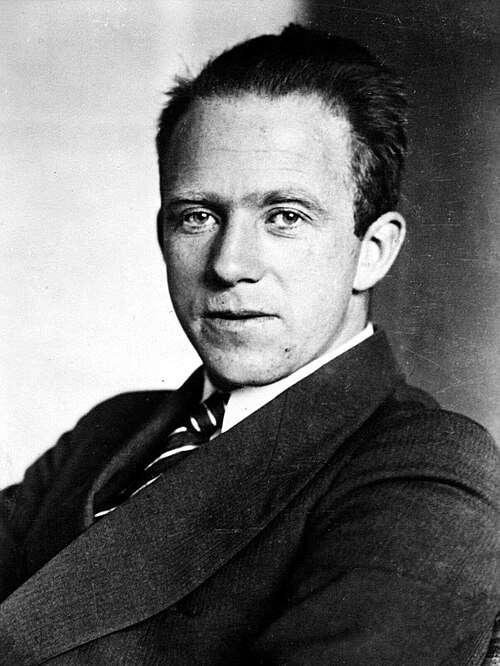
Werner Heisenberg
Werner Heisenberg
On the wall: The Riemann zeta function

The Riemann zeta function

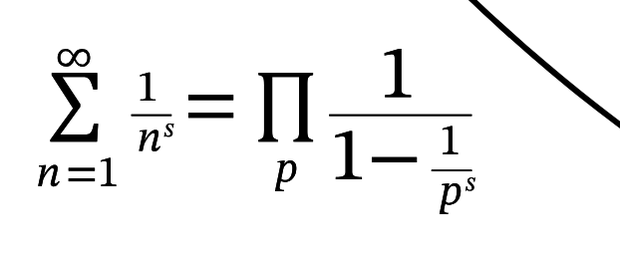
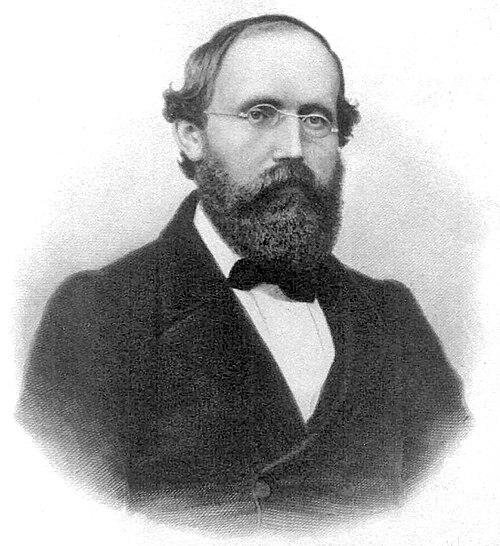
On the left of the wall's identity, a sum over every counting number: 1 + 1/2ˢ + 1/3ˢ + … On the right, a product over only the primes. Euler proved they are exactly equal — always. The smooth, orderly world of all numbers and the jagged, unpredictable world of primes are two descriptions of one thing.

Riemann pushed the function into the complex plane and found that the primes' apparent randomness is orchestrated by where this function equals zero. His 1859 conjecture about those zeros — the Riemann hypothesis — is now the most wanted proof in mathematics, with its own Millennium Prize. Internet cryptography leans on the primes' wildness daily; this innocuous-looking identity is where their secret order is kept.

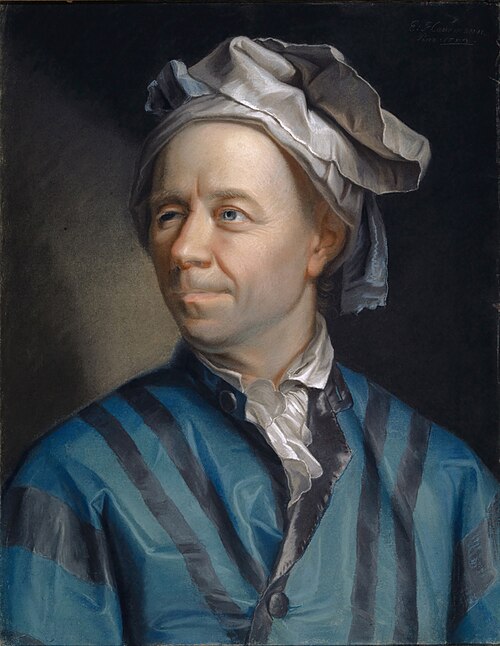
Leonhard Euler
Leonhard Euler
Bernhard Riemann
Bernhard Riemann
On the wall: Feynman and string interaction diagram

Feynman and string interaction diagrams

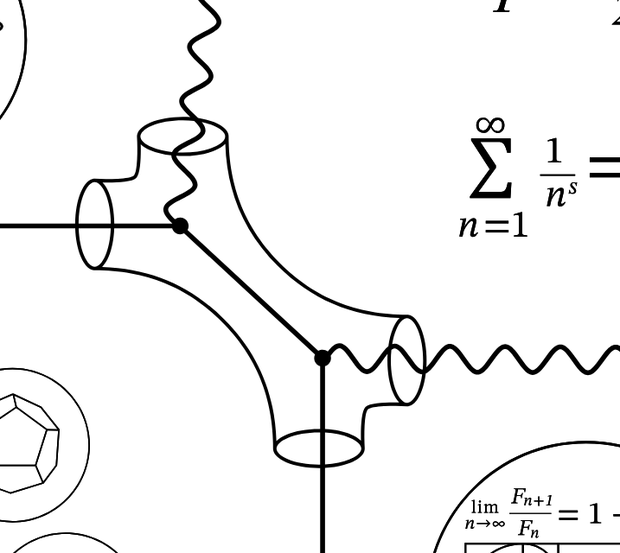
Feynman turned particle physics into cartoons: straight lines for particles, wiggly ones for photons — like the wiggly rays crossing this very wall — meeting at sharp points where particles collide. Behind each doodle sits a precise calculation; the doodles are why anyone can do it.

But those sharp meeting points breed mathematical infinities. String theory's remedy is drawn beside the Feynman graph: if particles are tiny loops rather than dots, a collision is two tubes merging into one — a smooth surface shaped like a pair of pants, with no sharp point anywhere for infinity to hide in. Two generations of physics, side by side: the diagram that tamed the quantum world, and the surface hoping to tame gravity.

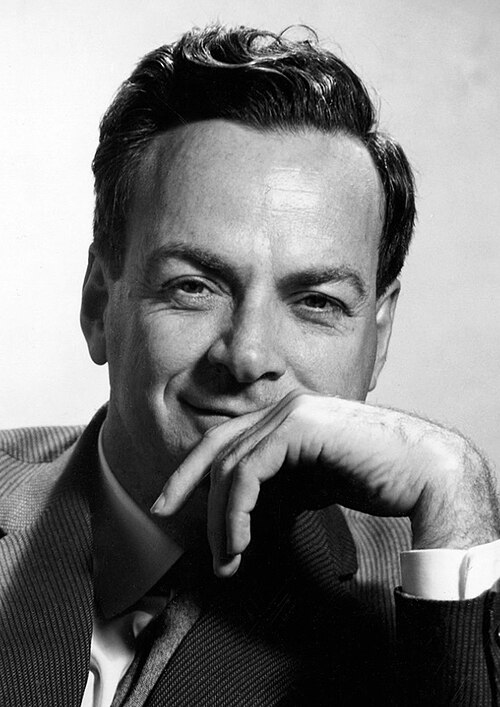
Richard Feynman
Richard Feynman
On the wall: Shannon’s information theory

Shannon's information theory

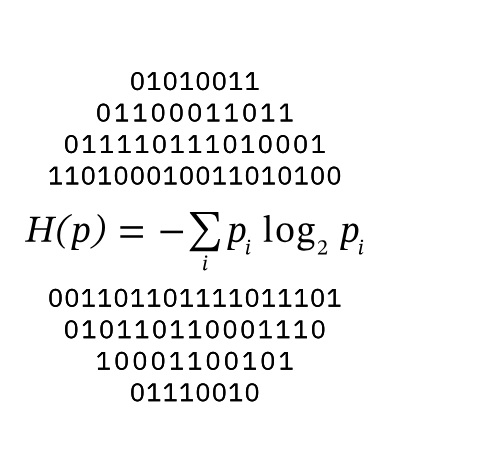
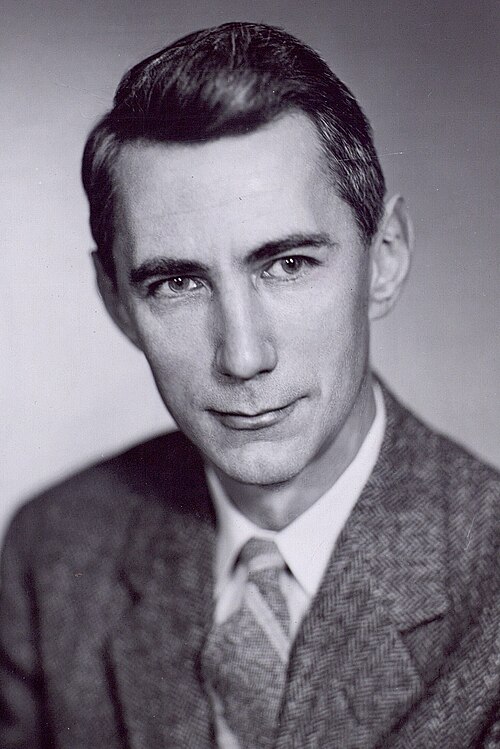
In 1948 a Bell Labs engineer asked a question nobody thought was mathematics: how much surprise does a message carry? Claude Shannon's answer, H(p) = −Σ pᵢ log₂ pᵢ, measures information in a brand-new unit he named the bit — and drew a hard ceiling on how far any message can be compressed and how fast any channel can carry it, forever, regardless of technology.

Everything digital lives under that ceiling: the file that zips, the call that stays clear through static, the stream that survives your worst wifi. The raw binary carved around the formula is the alphabet Shannon's theorem governs — two symbols, endlessly arranged, now carrying nearly all human communication. Added in the Mr. Consistency refresh — and promoted: information may be the substrate of the universe itself, a real thing woven into spacetime with gravitational consequences of its own. See Information Activation Theory on the main page for the full case — one informational field in place of cosmology's two great plugs, dark matter and dark energy.

Claude Shannon
Claude Shannon
On the wall: The Bekenstein–Hawking entropy formula

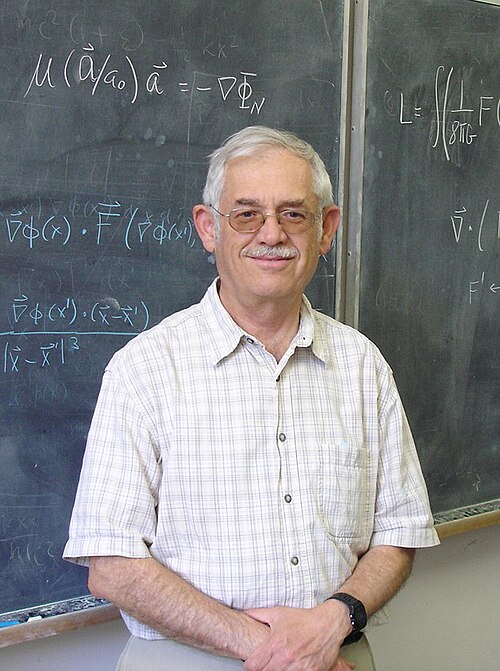
The Bekenstein–Hawking entropy formula

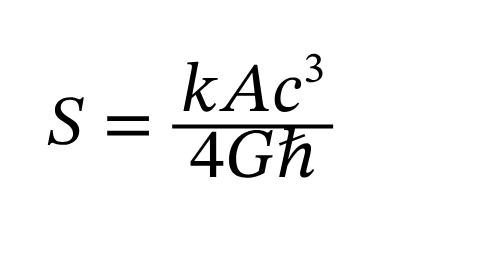
One line, four constants, four departments of physics: S = kAc³/4Għ carries Newton's G (gravity), Planck's ħ (quantum), Einstein's c (relativity), and Boltzmann's k (thermodynamics). No other equation makes all four shake hands.

It says a black hole has entropy — hidden information — and that the amount is proportional to the area of its horizon, not the volume inside. That is deeply strange: it hints that everything a black hole swallows is somehow recorded on its surface, like a three-dimensional room fully described by its walls. Physicists call the idea holography, and many suspect it applies to the universe at large. Bekenstein proposed the entropy in 1972; Hawking, trying to prove him wrong, instead fixed the constant and found black holes glow. Added in the 2026 refresh — the wall's newest stone, and its best candidate for the physics of the next century.
Jacob Bekenstein
Jacob Bekenstein
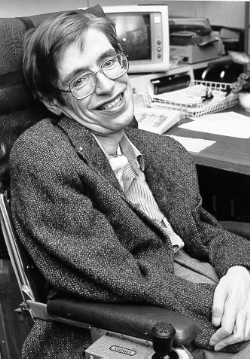
Stephen Hawking
Stephen Hawking

Portrait credits

Portraits are the lead images of each subject's Wikipedia article, via Wikimedia Commons, except where noted. Files and licenses:
Albert Einstein — Albert_Einstein_Head_cleaned.jpg, Public domain · Archimedes — Domenico-Fetti_Archimedes_1620.jpg, Public domain · Bernhard Riemann — Georg_Friedrich_Bernhard_Riemann.jpeg, Public domain · C. N. Yang — HD.3F.010_(11086446676)(Chen_Ning_Yang).jpg, Public domain · Carl Friedrich Gauss — Carl_Friedrich_Gauss_1840_by_Jensen.jpg, Public domain · Claude Shannon — C.E._Shannon._Tekniska_museet_43069_(2x3_crop).jpg, CC BY 2.0 · Claude-Louis Navier — Claude-Louis_Navier.jpg, Public domain · David Bohm — David_Bohm.jpg, Attribution · Edward Lorenz — EdwardLorenz.jpg, Attribution · Erwin Schrödinger — Erwin_Schrödinger_-_Narodowe_Archiwum_Cyfrowe_(1-E-939).jpg, Public domain · Fibonacci — Leonardo_Fibonacci.JPG, CC BY-SA 4.0 · George Stokes — Ggstokes.jpg, Public domain · Henri Poincaré — PSM_V82_D416_Henri_Poincare.png, Public domain · Isaac Newton — Portrait_of_Sir_Isaac_Newton,_1689_(brightened).jpg, Public domain · Isadore Singer — Isadore_Singer_1977_(re-scanned_2;_border-less)_(cleaned)_(cropped).jpg, CC BY-SA 4.0 · Jacob Bekenstein — Bekenstein100_(cropped).JPG, Public domain · James Clerk Maxwell — James-Clerk-Maxwell-1831-1879.jpg, Public domain · Johannes Kepler — JKepler.jpg, Public domain · Julius Wess — Julius_Wess.jpg, CC BY-SA 2.0 de · Karl Schwarzschild — Karl_schwarzschild.portrait.jpg, Public domain · Leonhard Euler — Leonhard_Euler_-_Jakob_Emanuel_Handmann_(Kunstmuseum_Basel).jpg, Public domain · Michael Atiyah — Michael_Francis_Atiyah.jpg, CC BY-SA 2.0 de · Nikita Nekrasov — photo Sean Lewthwaite / Nina Mikhailyuk, courtesy Stony Brook University · Paul Dirac — Paul_Dirac,_1933.jpg, Public domain · Pierre Ossian Bonnet — Pierre-Ossian-Bonnet.jpg, Public domain · Plato — Plato_Silanion_Musei_Capitolini_MC1377.png, Public domain · Pythagoras — Pythagoras_in_the_Roman_Forum,_Colosseum.jpg, Public domain · Richard Feynman — Richard_Feynman_Nobel.jpg, Public domain · Robert Mills — Robert_Laurence_Mills_(cropped).jpg, CC BY-SA 4.0 · Rodney Baxter — Baxter,_Rodney_James_(1940)_(cropped).jpeg, CC BY-SA 4.0 · Stephen Hawking — Stephen_Hawking.StarChild.jpg, Public domain · Vaughan Jones — Vaughan_Jones_2018_(cropped).JPG, CC BY-SA 4.0 · Werner Heisenberg — Werner_Heisenberg_Portrait_(3x4_cropped).jpg, CC BY-SA 3.0 de · Yakir Aharonov — Yakir_aharonov.jpg, CC BY-SA 3.0