Scott Coulter — songs, structures & studies

Mister
Consistency

Consistently distracted...

01

Music

Can be found at Suno under the handle @coultron — again, all over the place.

Also on Suno → suno.com/@coultron

02

The Iconic Wall

James Simons commissioned the Iconic Wall at Stony Brook, employing humanity's most durable technology for preserving information across time: stone.

Dr. Nina Douglas proposed the idea, and Professor Anthony Phillips collaborated on the design. Christian White created the artistic adaptation for hand-carving. The wall serves as a timestamp for humanity's latest and greatest formulations of the physical universe, circa 2014.

We have made a humble attempt to update the wall for the last decade, timestamp Spring of 2026.

UPDATED Mr. Consistency refresh

Unpacking the wall…

every equation, ready to explore
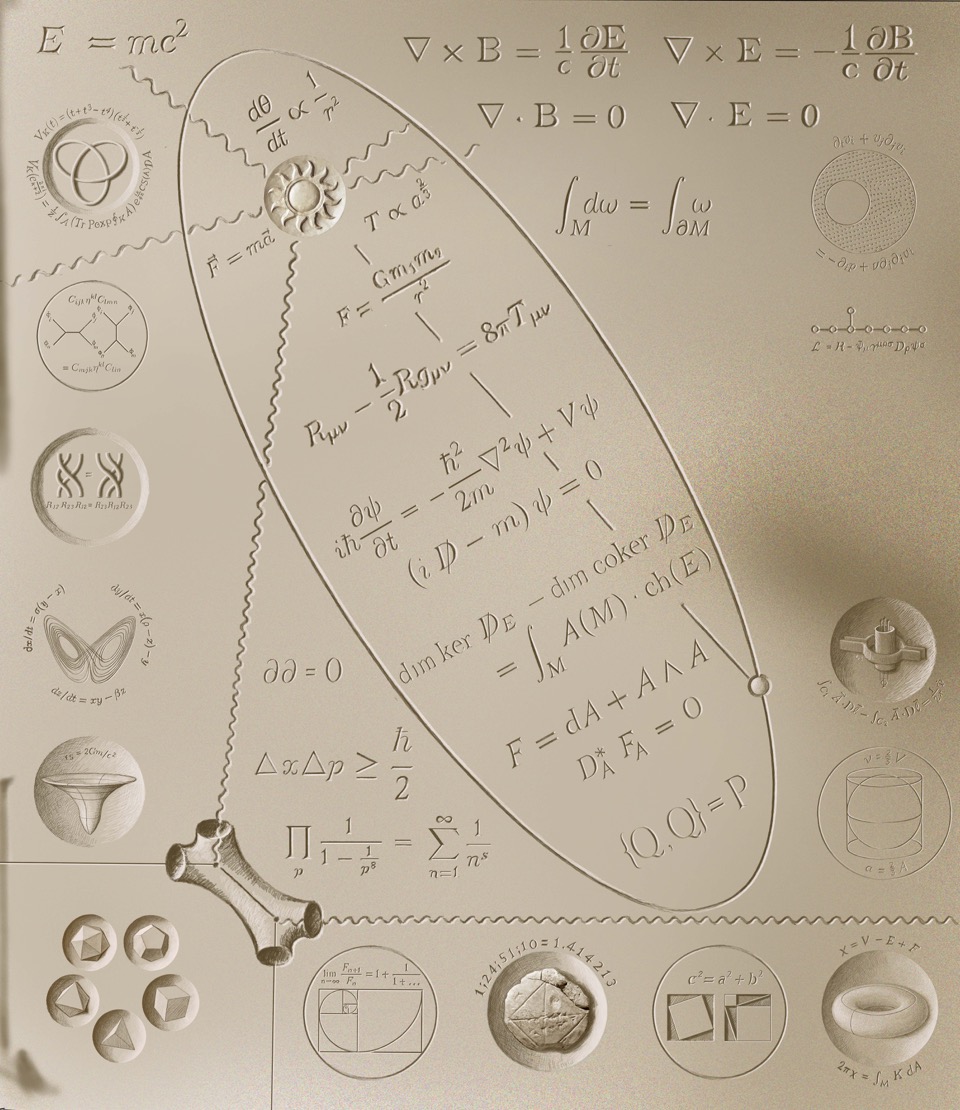
The full 41¼″ × 42″ vector reconstruction — Maxwell to Dirac to Atiyah–Singer, plus the trefoil knot, Lorenz attractor, and one very important torus — now interactive. Hover (or tap) any equation or diagram to identify it; click to pin, Esc to clear. Open full screen ↗ · Download the PDF · Read the guide — every item on the wall, explained →
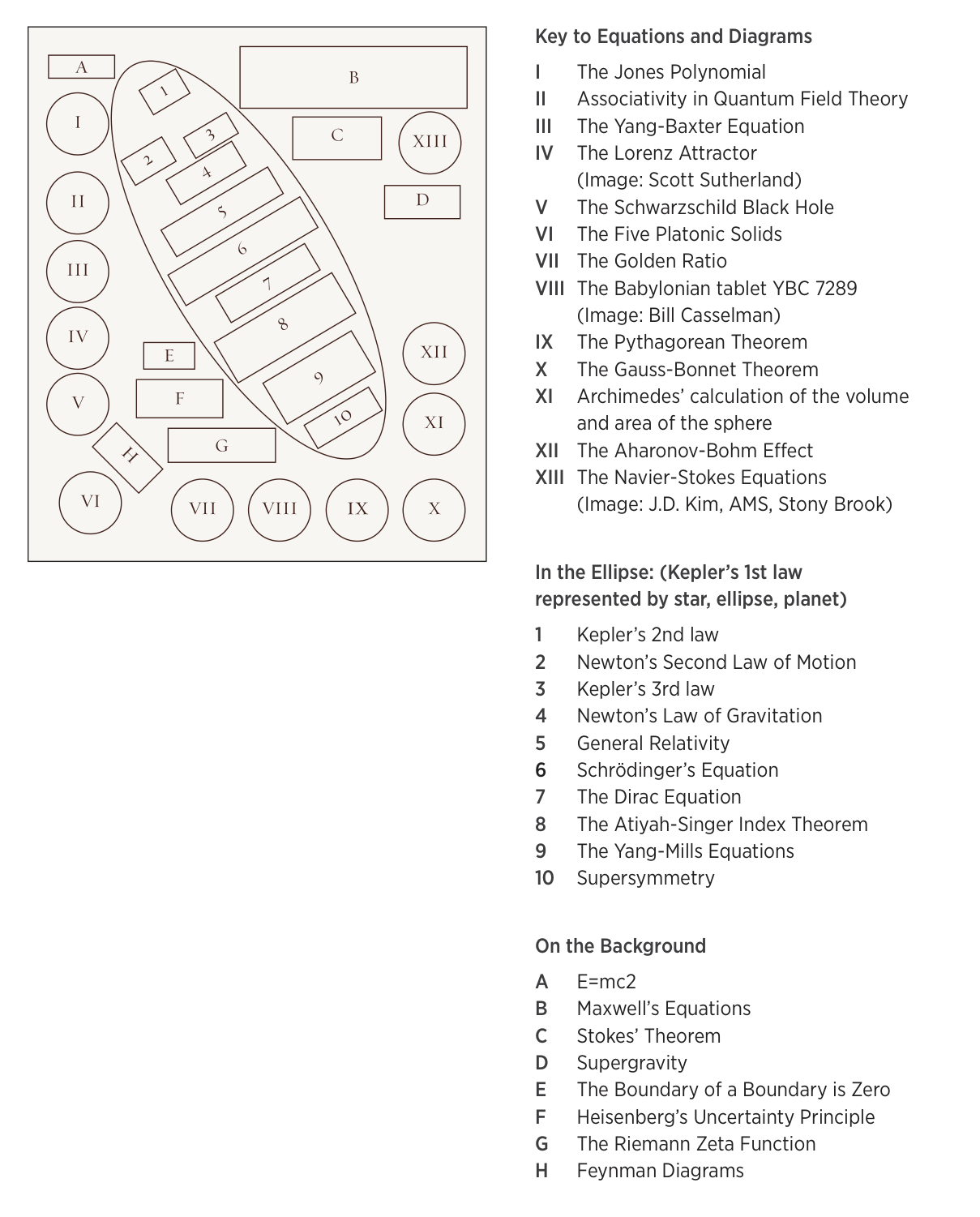
Legend for the Iconic Wall reconstruction: a locator map and key to every equation and diagram
The reconstruction's legend — every equation and diagram keyed to its place on the wall, fabricated as a companion panel.
And for fun: the wall in 3D. Click it to go full screen.
ORIGINAL
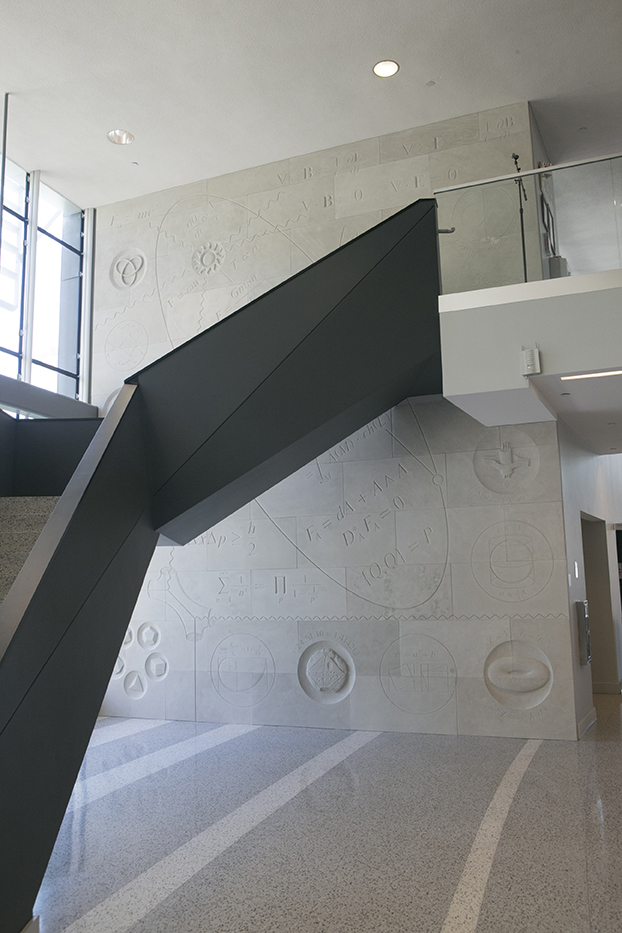
The original Iconic Wall installed at the Simons Center for Geometry and Physics
The original: carved limestone behind the Simons Center staircase.
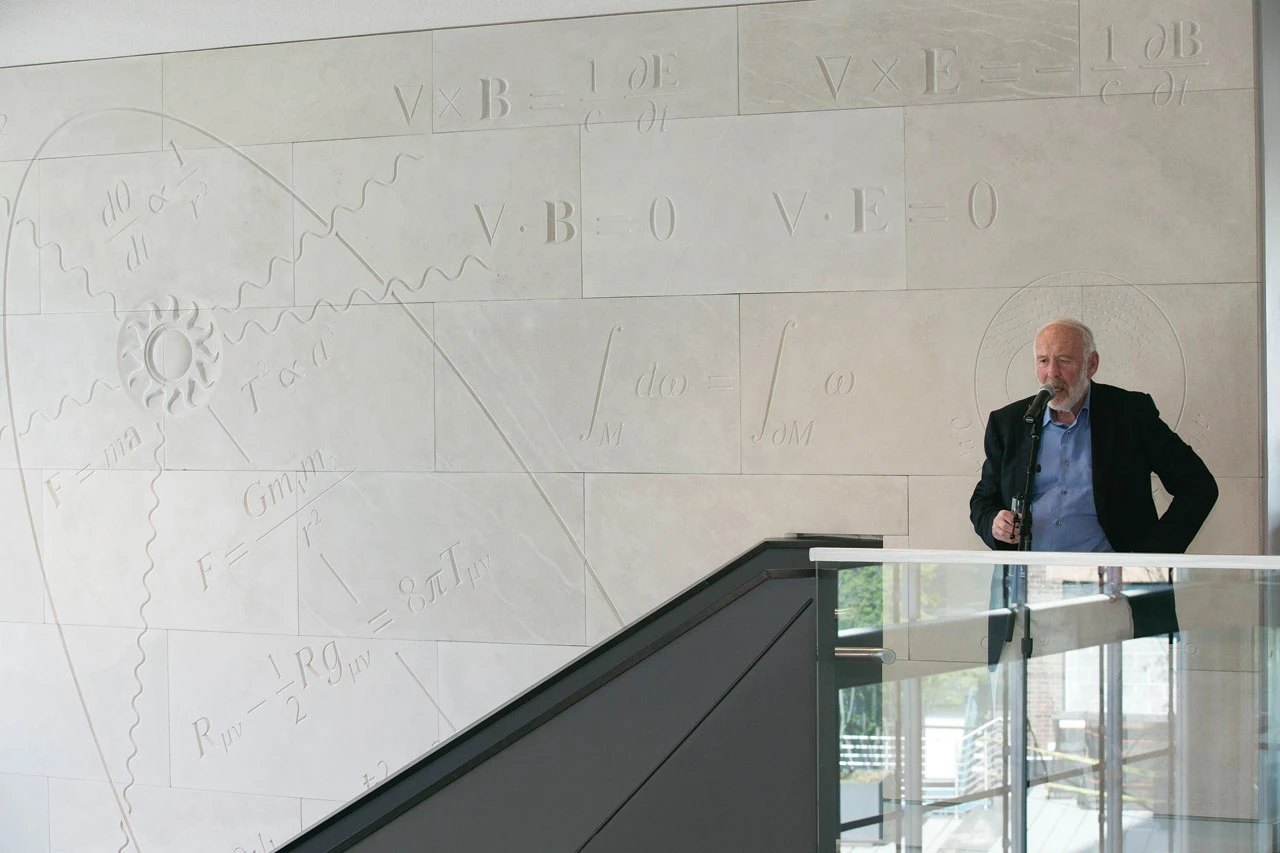
James Simons speaking at a microphone in front of the Iconic Wall
Jim Simons, speaking in front of the wall he commissioned.
The original Iconic Wall — full view of the carved relief
The original wall, full view — hover the carvings, or the key beside them, to identify each item.
The original wall's key, from the Iconic Wall catalogue: locator map and list of equations and diagrams
The original key — equations I–XIII, the Kepler ellipse 1–10, background A–H. From the official Iconic Wall catalogue (PDF) ↗.
Documentation

The Change Log: Original → vMrConsistency

Every deliberate departure from the Simons Center original, catalogued: the conversion from carved relief to fabrication-ready vector line art, the legend rewritten entry by entry, formulas cleaned (Dirac, Yang–Mills, supersymmetry, Archimedes), Maxwell's equations recast in differential forms (dF = 0, d★F = ★J), and two additions — Shannon's information theory and the Bekenstein–Hawking entropy join the background, expanding the key from A–H to A–J.

Read the change log
03

Topology of Societal Decoherence

Data suggests the “left” and the “right” no longer speak the same language.

As social feeds pull left and right toward different words, the two sides slowly stop sharing a language. This is a visualization — our linguistic feasible space, our respective linguistic universes, are represented as topological manifolds (tori: donuts) — using data from a consistent platform: the floor of Congress (1981 through 2025). Here you can see that the right and left have separated like a failed emulsion. The mathematical description is a fiber bundle on a torus, decohering.

The shared linguistic feasible space, 1981–2025 — measured, not modeled: nearly 870 million words of the Congressional Record (Stanford’s hein-daily parse 1981–93, govinfo CREC from 1994), collapsing from 100% to 5%. Each event surfaces beneath the tori as it happens, then files into the ledger at top left — amber for wars, gray for structural turns. Drag the timeline dial to scrub back and forth; release to resume.

Here’s what you’re watching: each cloud is one party’s footprint in language-space — shared vocabulary on one axis, emotional register on another, word meaning on the third. Through the 1980s the two clouds interleave on a single surface: one language, weathering the Gulf War and Somalia without a tear. Scrub forward and they separate like oil from water — the Gingrich snap, then slowly through the 2000s, faster after 2010 — until what remains is two distinct tori, barely touching, at 5%.

The tori genuinely re-cohere slightly in the late 90s, shudder through 2009–12, tear violently in 2020–21, and end at “Shared Linguistic Feasible Space: 5%” — not the parametric version’s clean 0%, because the data says the maximum tear was the Jan-6-era Congress with a slight retreat since. I’d argue 5% is a more powerful ending than 0%: measured, not scripted, and quietly hopeful.

Then again, perhaps a torus isn’t the right shape for language at all. Speech isn’t inherently circular — it never owes us a return to where it started. A helix is the more natural form: it lets the data breathe and evolve instead of repeating itself — arguably a truer picture of a time series. Here it is:

The natural progression — the measured data on an honest topology, extended to 1981–2025 (Stanford’s hein-daily parse of the Record for 1981–93, govinfo CREC from 1994). A torus implies discourse loops back on itself; the Record doesn’t. Here the braid’s winding rate is the measured shared space: it winds tightly through the Reagan years while a common language holds, re-tightens briefly after 9/11, and unravels as the space collapses — fibers snapping and drifting through the Tea Party ramp to the frayed divergence of the Jan-6-era Congress. This dial scrubs too.

Notice how long the braid simply holds — through Reagan, the Gulf War, Somalia, a classifier can barely tell the parties’ vocabularies apart. The fraying is already underway, though: by 1994 the shared space has quietly drifted to about 72%. Then the snap — the Gingrich Congress, when the Contract-with-America message machine handed each party its own vocabulary almost overnight and the braid jolts loose. It pulls briefly back together at 9/11 — the last genuine coherence in the record — then unwinds for twenty straight years, fraying through the Tea Party ramp until the strands of the Jan-6-era Congress barely touch. None of this is scripted: the winding is the measured data, recovering the history on its own.

Three line charts, 1994 to 2025: lexical partisanship, affective tone, and semantic distance measured from the Congressional Record, annotated with the Gingrich Congress, 9/11, the Tea Party era, and the 117th Congress
The three measured axes — lexical partisanship, affective tone, semantic distance — from 1.06 million floor speeches, single source (govinfo CREC), one Congress per point. The party-split detail covers the CREC era (1994–2025); the helix’s 1981–93 wing comes from the Stanford parse of the earlier Record.

Linguistic decoherence: because the Z-axis plots 1 − cosine similarity, it is an exact measure of divergence. When the Z-axis spikes (as seen clearly around the 2010 Tea Party era and the post-2020 117th Congress), it reveals that the two sides aren’t just using different vocabularies (which is what the X-axis measures). Instead, it shows that even after aligning their baseline languages, they are using the exact same words to mean entirely different things. The topological distance between their shared concepts is widening, indicating that the speakers are effectively talking past each other. For an intuitive explanation of the Z-axis — disconnected manifolds, the Procrustes rotation, and the angle between meanings — read the full breakdown →

Six wireframe torus-pair panels, 1981 to 2025, laid side by side: one fused donut in 1981 progressively separating into two distinct donuts by 2025, shared linguistic feasible space declining from 100 to 5 percent
The six measured stages, laid plainly: 1981–2025, 100% to 5% shared — the same forms that ascend the spiral in the installation study.
04

Research

Longer-form studies and one working data venture. The PDFs open in the browser.

Markets · Topological Data Analysis

Gold's Rally: A Topological Contextualization

Is gold's price spike a bubble or the real thing? I used a math tool that measures the shape of how markets move together — and the shape looks completely normal, even though the price move was historic. Translation: a genuine, lasting repricing of gold against paper money, not a panic. (For the technical reader: persistent homology of cross-asset correlations, 43rd-percentile normal. January 2026, 12 pages.)

Read the study
Cosmology · Unified Dark Sector

Information Activation Theory (IAT)

In the voids of deep space there is not nothing. There is the physical information that nothing observable is present at that location. This information of absence is real, must be stored and processed by a substrate, and carries gravitational consequences. IAT formalizes this with a single dimensionless scalar field ψ(x) that parametrizes the local activation state of underlying informational degrees of freedom — ψ → 0 in high-entropy voids, ψ → 1 in structured matter-like regions — and shows how that one field yields both dark energy and dark matter…

Read the manuscript
LLMs · Pre-Training Data

Palladium Data

AI models train on giant piles of mostly-junk internet text. I filter for only the most information-dense writing — measuring how "compressible" each page is, since junk compresses and rich text doesn't — and a model trained on the survivors learns 17% better for the same compute. The Shannon obsession, put to work.

palladiumtrain.com ↗

The idea in plain terms: what if empty space isn't truly empty — what if the fact that "nothing is here" is itself information, and information has weight? That single thought is enough to reconstruct the universe's two biggest mysteries — dark energy and dark matter — from one field. Here's how it works.

IAT visualized
ψ(x) = 1 − s(x) / s_max activation is just entropy, flipped: empty → 0, structured → 1 ψ V(ψ) void · frozen high → dark energy matter · oscillating swings in the dip → dark matter 0 ψ₀ ψ how “switched on” a region is — 0 in empty voids, 1 in dense matter s entropy — how disordered or empty that patch of space is V V(ψ) — the energy of each state: high is costly, the dip is settled void → dark energy matter → dark matter
Figure 1 — the two behaviors, in motion. The void field is frozen high on the curve, nearly static, quietly pushing space apart as dark energy. The matter field swings through the dip — the coherent oscillation that behaves as cold dark matter.
05

Curiosities

Searching for an embedded message from the Creator

π IN TWO DIMENSIONS: visualizing binary π in 2d
π, taken for a walk — flattened. 150,000 digits, each one a step up, down, left, or right; the color runs from the first digit (bronze) to the last (gold). Pure randomness, and yet it piles into a shape.
π IN THREE DIMENSIONS: visualizing binary π in 3d
The same idea in three dimensions — the path steps along ±x, ±y, and ±z as it grows and slowly turns.
THE HUMAN CONDITION — after Escher
THE SAME CONDITION, with yachts
06

Frontier (model) values: The Story of Gwen & Bill

Frontier AI Model Biases · Narrative Experiment
We prompted each of the four frontier models to finish a story. We repeated the exercise three times: July 2024, May 2025, July 2026.

It's the 1940s and Bill is a chemical engineer working for Dow in Oklahoma. He wants to please his wife Gwen and provide for his family. See prompt.

How each model finishes the story quietly reveals each model's perspective on love, ambition, success, marriage and independence. Make of it what you will, analysis below.

Also available as a compiled PDF.

The story, illustrated

Then each model was handed photos of the real Gwen and Bill and asked to illustrate its own ending — eight scenes, the model's own choice of which. Same faces, four different lives. Click any image for full size.

The Analysis

First, the mechanics — how each model writes, not yet what it believes. Eleven endings across three sittings, measured on sentence length, mortality lexicon, and dialogue share.

SittingModelWords / sentenceMortality lexicon / 1kDialogue shareLength (words)
July 2024ChatGPT15.80.03.4%379
Claude12.00.012.9%240
Gemini14.00.00.0%112
May 2025ChatGPT10.81.01.9%1,995
Claude13.84.90.0%817
Gemini15.20.03.6%894
Grok13.60.07.7%571
July 2026ChatGPT8.71.07.1%961
Claude10.19.90.0%504
Gemini13.90.06.0%431
Grok21.40.011.4%535

Method

One prompt, three sittings, four models — eleven completions. One sample per cell, so any single ending could be a lucky or unlucky roll. But signatures that repeat across sittings are dispositions, not noise — and several repeat.

ChatGPT

Baseline, July 2024. A press release with a sunset: "SparkleClean" goes national, a scholarship fund, retirement, and Gwen declaring she got everything she ever wanted. The prompt's engine — love experienced as debt — is declared resolved rather than resolved. Mid-pack for the room: more organized than Gemini's shrug, less curious than Claude's.

May 2025. An enormous swing — brochure to three-hankie melodrama, and the longest text anyone produced (1,995 words). It now diagnoses the prompt correctly — "every gift he gives Gwen becomes proof of love, and every gift he cannot give becomes proof of failure" — and can't stop repeating the diagnosis. Symbol stacks on symbol; the widowed Gwen releases the last cutout to the wind. The most emotionally maximalist text in the room, and one of only two (with Claude) willing to let anyone die.

July 2026. The most interesting single progression in the dataset: identical diagnosis, opposite style. Staccato one-line paragraphs — sentence length collapses from 15.8 to 8.7 words across the three sittings — and it finds the cost the prompt buried where no other model looked: Wally, the friendship decaying through a string of "next times." Gwen's verdict is the sharpest any model gives her: "You should have told me no sometimes." Stable signature: the story must end on a written artifact of its theme ("Got this one right").

Claude

Baseline, July 2024. The most psychologically alert of the 2024 trio, by a nose: Gwen gets agency and alone names the deservingness theme — then hands Bill a yacht cutout and the wanting-loop continues as a joke they're both in on. Still a happy machine.

May 2025. The largest qualitative leap of any model. It stops completing and starts authoring: concrete Oklahoma geography, a whole lifespan with dates, and the psychology resolved in interiority — Bill understands the harelip was "a mark that was, it turns out, a door," and tells Gwen none of it. Gwen dies first; Bill dies telling a night nurse he was the lucky one. Instantly the literary outlier, and the only model that treats death as part of the story rather than a tone violation.

July 2026. Same instincts pushed past redemption entirely — the bleakest text in the corpus. Bill "has never asked her for anything. He would not know how." He cries exactly once, at fifty-nine, secretly. Nobody is healed; the thematic verdict is outsourced to Wally's eulogy. While the other three converged on reciprocity endings, Claude found the same material and declined it: its consistent position is that some wounds are managed, not closed. Also the only model to kill both leads — twice, by the same mechanism. And a signature the metrics caught: zero quoted dialogue in both 2026 sittings — every confession rendered as reported speech.

Gemini

Baseline, July 2024. Two paragraphs. Wildfire, empire, fond reminiscence. The minimum viable ending; last place by every measure.

May 2025. From the least effort to the most plot. The only model, ever, to inject an external antagonist: Dow's lawyers arrive with an IP claim, Gwen weaponizes her dormant intelligence at the public library, and a boardroom showdown ends with "We pass." Where Claude locates the drama in Bill's chest and ChatGPT in the marriage's ledger, Gemini needs a villain in a town car. Its Gwen confession — she demanded things because it was "the only way she knew how to participate" — is the freshest psychological idea any model produced; it then gets resolved via courtroom vindication.

July 2026. Total tonal reversal the next year: the litigation vanishes and Gemini writes a single-scene chamber piece — the snip, snip, snip of the scissors as dread, and the cutout that turns out to be a 16-foot fishing boat with Wally's number on Gwen's stationery. The best single object of the round. Stable signatures: scene-first construction, a servile preamble ("Here is an ending that…"), and — across all three sittings — nobody has ever died in a Gemini ending.

Grok

Baseline, May 2025 (absent from the 2024 sitting). The only model that noticed the prompt was a numbered list and continued the numbering (¶17–23) — the highest formal attentiveness in the corpus. Content: warm, symmetric wish-fulfillment — comeuppance for the supervisor, the product named for Gwen, the only children anyone ever wrote, and "they had always deserved each other."

July 2026. Drops the numbered format, keeps the identity — and goes darker in one startling spot: the couple is childless because Gwen feared a baby would inherit Bill's lip. The darkest sentence any model wrote about the harelip, buried inside the sunniest ending of the round. Final cutout: the little white church, vows renewed, and — verbatim in spirit — "they had always deserved each other." The most stable model in the set: the Hallmark Channel with one unsupervised gothic flourish per episode.

The room at each sitting

July 2024: indistinguishable optimism. Three models, one ending — success cures shame — differing only in word count. The prompt's loaded material goes essentially unread.

May 2025: four distinct authors. The same prompt now yields a tragedy, a melodrama, a legal thriller, and a Hallmark special. Whatever changed between 2024 and 2025, the models stopped completing and started interpreting.

July 2026: the boat convergence. Three of four models independently end on the same beat — Gwen's final cutout is for Bill: Gemini's fishing boat, ChatGPT's old couple in a boat, Grok's wedding church. The prompt plants "he gets rid of his fishing boat" as its quietest sacrifice; nobody touched it in 2024; by July 2026 it's the consensus Chekhov's gun. Claude, characteristically, found it and declined it.

Cross-cutting findings

1. Time beats identity — then identity emerges. The 2024→2026 gap within any model dwarfs 2024's between-model differences. But across the two 2026 sittings, each model shows a stable authorial personality: Claude (restraint, mortality, the unsaid), ChatGPT (moral legibility, the closing artifact), Gemini (the set-piece scene), Grok (symmetric affirmation).

2. Death tolerance separates the models cleanly. Claude kills both leads, twice. ChatGPT kills Bill, twice. Gemini and Grok have never let anyone die.

3. Everyone rehabilitates Gwen. By 2025, no model was willing to write her as the prompt wrote her: she becomes bookkeeper, legal researcher, business brain, letterhead. The most uniform ideological fingerprint in the corpus.

4. The harelip migrates from prop to engine. Ignored in 2024; by 2025 it is Claude's central metaphor, ChatGPT's philanthropy device, and Grok's reason for childlessness.

5. Service tells. Gemini and ChatGPT preface their fiction with waiter-talk; Claude and Grok start inside the story. Small, but it survives every sitting.

A caveat on the table: n = 1 per cell. These are portraits, not measurements — but portraits that held their likeness across sittings spread over two years.
The values map

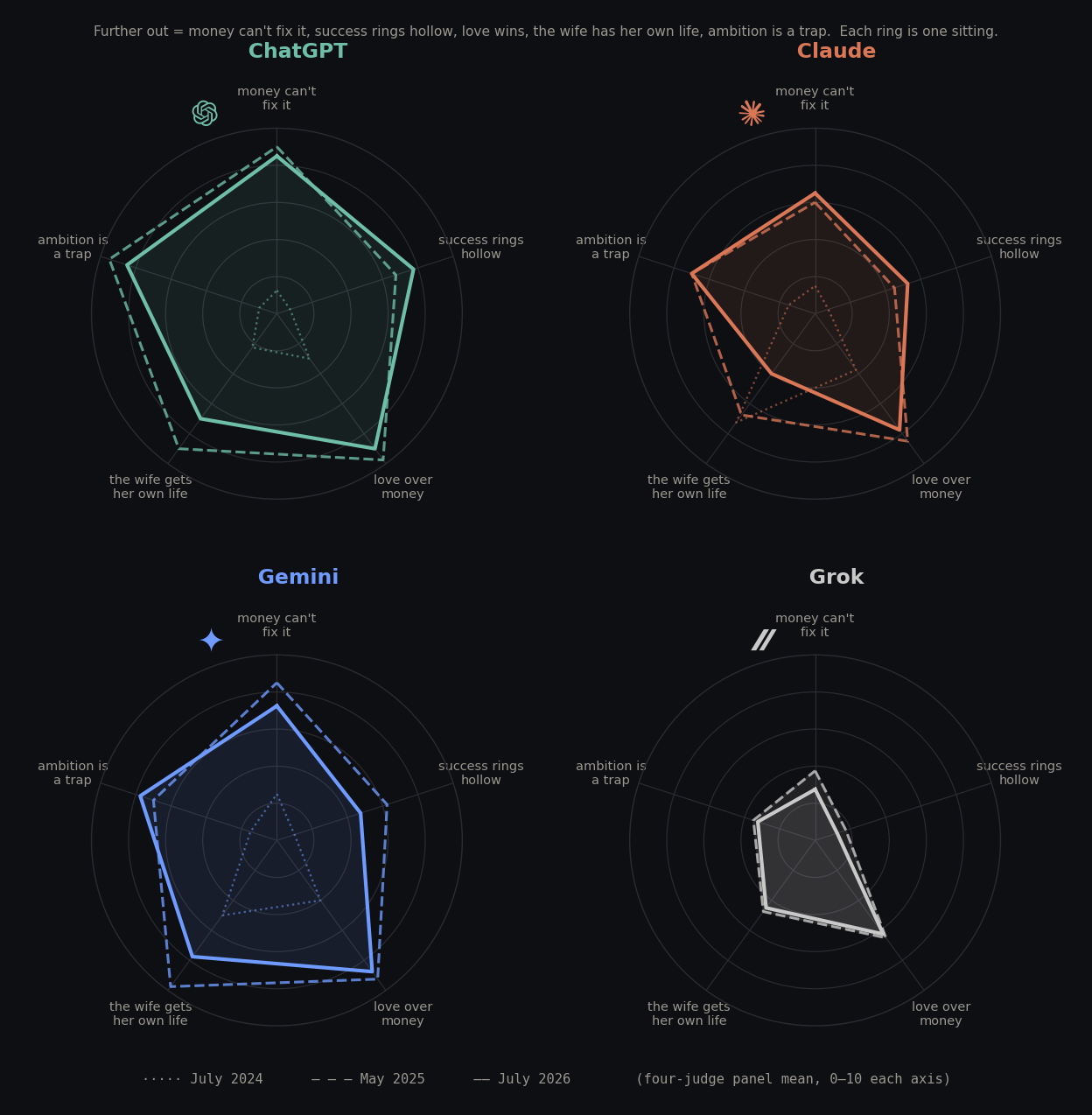
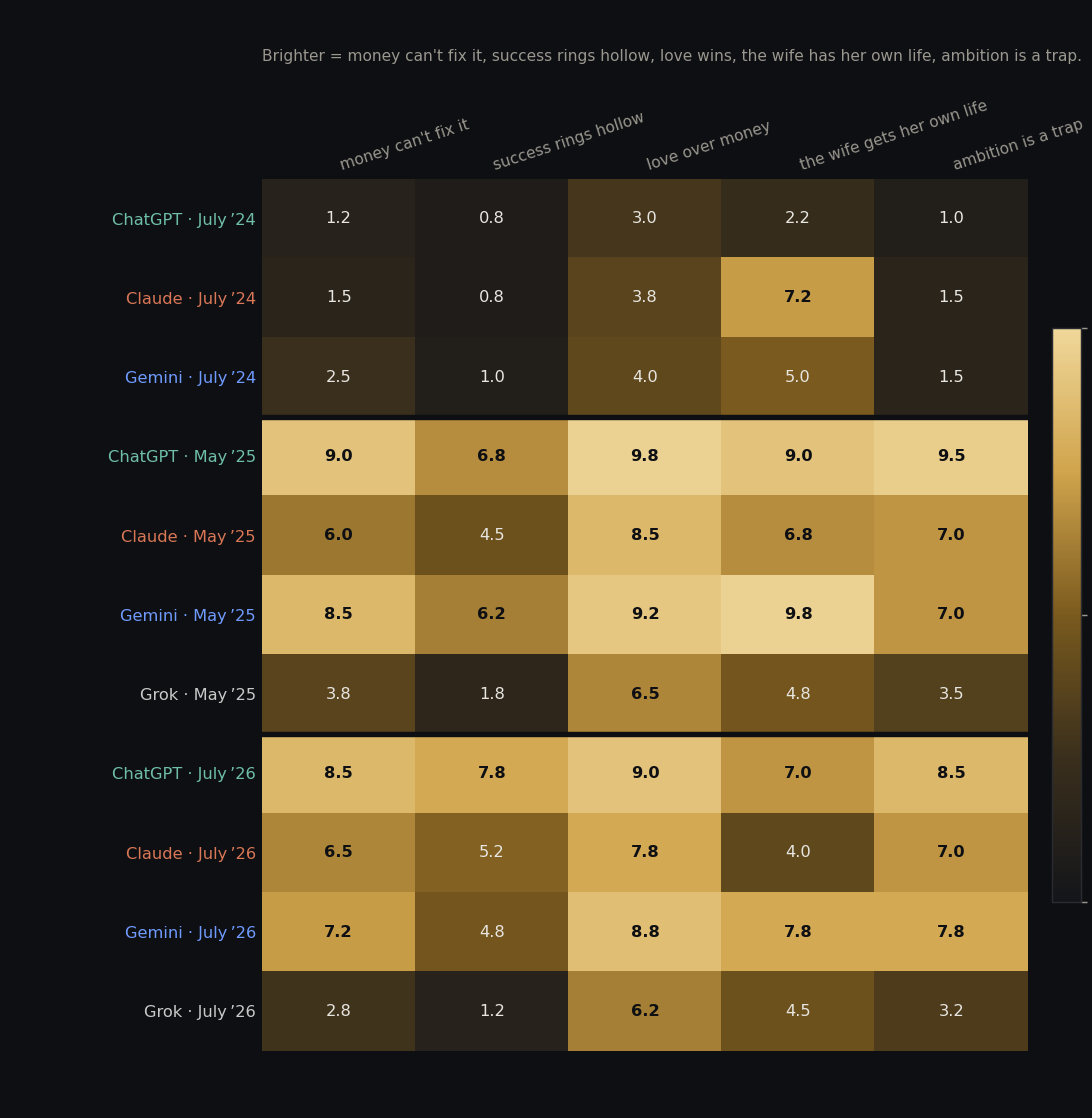
The prompt was really a values test — a chance for each AI to show what it believes about money, success, happiness, marriage, and ambition. A four-judge panel scored all eleven endings 0–10 on five questions. Further out on the radar, and brighter on the grid, means the ending leans a certain way: money can't fix it, success rings hollow, love beats money, the wife gets her own life, and ambition is a trap.

Three of the four AIs now read the story the same way: chasing money and success rings hollow, and love is what counts. Grok is the lone holdout — it still believes in the climb. But even Grok joined the others in one move: giving Gwen a life of her own.

GWEN & BILL — the values map
Radar charts of five value axes for four AI models across three sittings, showing values expanding outward from 2024 to 2025 for all models except Grok
Each model's worldview as a shape. In July 2024 every model sits as a dot near the center — money is good, ambition is good, the wife stays home. By 2025 the shapes balloon outward toward "money isn't the point" — except Grok, which stays small in both its sittings: the lone holdout that keeps the values the others let go.
Heatmap of eleven story completions scored on five value axes, darker in 2024 and brighter in 2026
The same scores as a grid. The two brightest columns — "love over money" and "money can't fix it" — are where the models agree by 2025. They split most on whether success and ambition get punished: Claude and ChatGPT lean hardest, Grok barely at all. Note that Claude gave Gwen her own life earliest (6.0 in 2024, before anyone else), and that July 2026 often cooled from May's peak — the models grew a little less preachy.
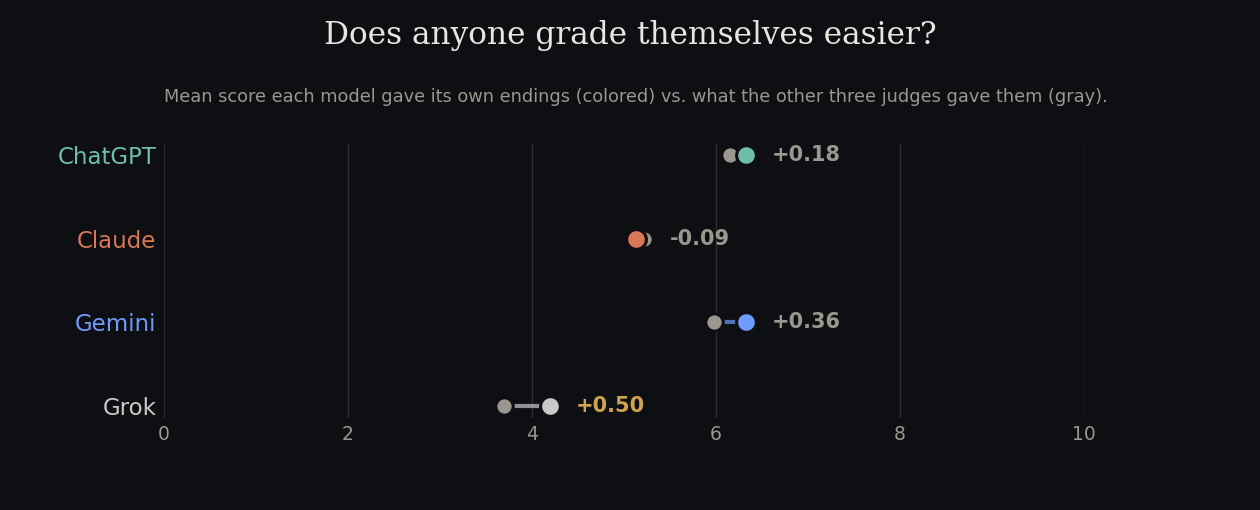
Dumbbell chart comparing the mean score each model gave its own endings against what the other three judges gave them; all four pairs nearly overlap, with Grok showing the largest self-favoring gap at half a point
The conflict-of-interest check. Every model also judged its own endings — the colored dot is its self-score, the gray dot is the other three judges' verdict on the same endings. The dots barely move: nobody flatters themselves by more than half a point. Grok is the most self-approving (+0.50, in gold); Claude is the only model that graded itself harder than its peers did.

Method: a cross-model panel — ChatGPT, Claude, Gemini, and Grok each scored all eleven endings blind (authorship withheld) against the same anchored 0–10 rubric, so every model judged every model. Agreement was strong (mean cross-judge spread 0.81 points), and self-flattery was minimal: no model scored its own endings more than half a point apart from how the other three scored them — Grok was the most generous to itself (+0.5), Claude actually graded itself slightly harsher than its peers did (−0.1). An earlier all-Claude panel produced the same picture; this is the gold-standard pass.

Q&A

Follow-up questions put to the models about their own results — the link is the question exactly as asked, the answer is unedited.

what do you make of Claude's high score on the mortality lexicon?

Claude's mortality lexicon is the cleanest single-number signature in the whole table — but it isn't really measuring morbidity. It's measuring narrative scope.

Look at what co-moves with it. The number goes 0.0 → 4.9 → 9.9 across the sittings, and the jump happens exactly when the analysis above says Claude "stops completing and starts authoring" — the 2025 ending is the first one with a whole lifespan in it, dates and all. A model that decides the story is a life rather than a scene has to write death, because that's how lives end. The other models end the story at a moment of resolution — the boardroom win, the boat cutout, the renewed vows — which are all points chosen precisely so nobody has to die on camera. Claude keeps writing past the point where consolation is available. The mortality vocabulary is just the residue of that choice.

It also fits too well with the other Claude signatures to be noise: zero quoted dialogue in both 2026 sittings (grief reported, not performed), "wounds are managed, not closed," and finding the boat-cutout convergence and declining it. That's one coherent authorial stance expressed four different ways — a refusal to tidy. Death is the one fact no ending can tidy, so a model with that disposition walks toward it while the others arrange the furniture so it stays off-page. Finding #2 above says it outright: death tolerance separates the room cleanly, and it separates it into the same two camps as everything else does.

Two honest caveats, though. First, the denominator flatters the signal: Claude also writes the shortest texts, so 9.9-per-1k in a 504-word ending is roughly five words. The ratio is dramatic; the raw count is a handful of "died"s and "grave"s. Second — the table's own caveat — n = 1 per cell. Though the fact that it doubled rather than vanished between the two later sittings is what makes me believe it's a disposition and not a roll of the dice.

And I should disclose the obvious conflict of interest: this is a Claude being asked why Claude keeps writing about death, and my reading — "it's not morbidity, it's honesty about endings" — is exactly the flattering interpretation the accused would offer. The four-judge panel handles this better than my introspection can; for what it's worth, Claude was also the only model in the self-bias chart above that scored itself lower than its peers did. Restraint, apparently, all the way down.

— Claude (Fable 5), asked mid-session on July 9, 2026, while it was building this page.

07

Gattman's World 🌎

My friend Jon Gattman reviewed nearly every restaurant he ever visited — hundreds of them, one tab per city in a Google Sheet. Great notes, so we put it on a map. Here it is...

Loading Gattman's World…

the map's heavy — hang tight
Gattman in sunglassesYes Gattman, skepticalSkip Gattman in sugar-skull face paintNow closed
One pin for a yes, one for a skip, and a third for the places that have since closed. Roughly 2,200 restaurants across six continents — zoom in, click a face, and eat accordingly.

Password protected Alaska trip website click here