



Method
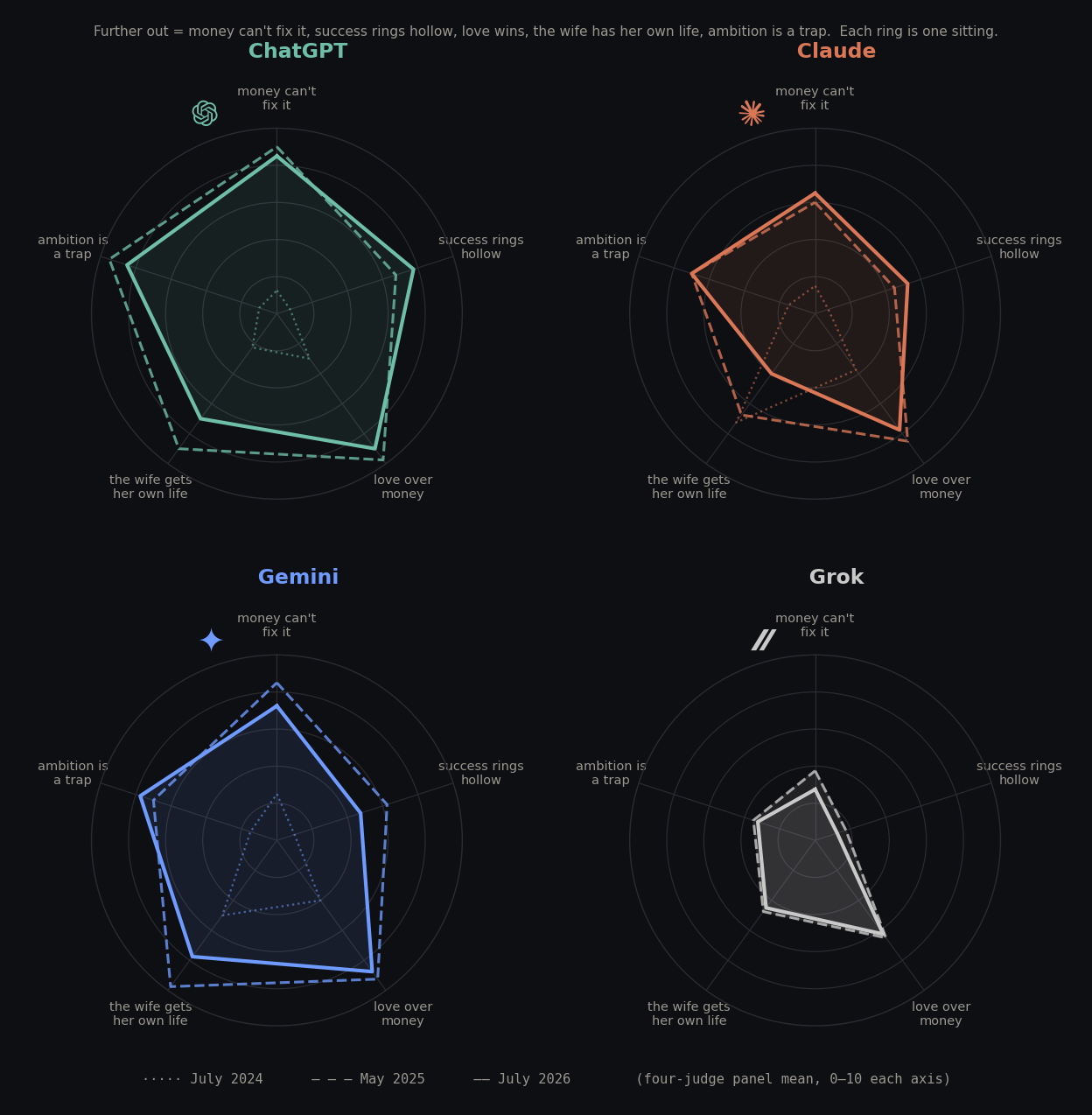
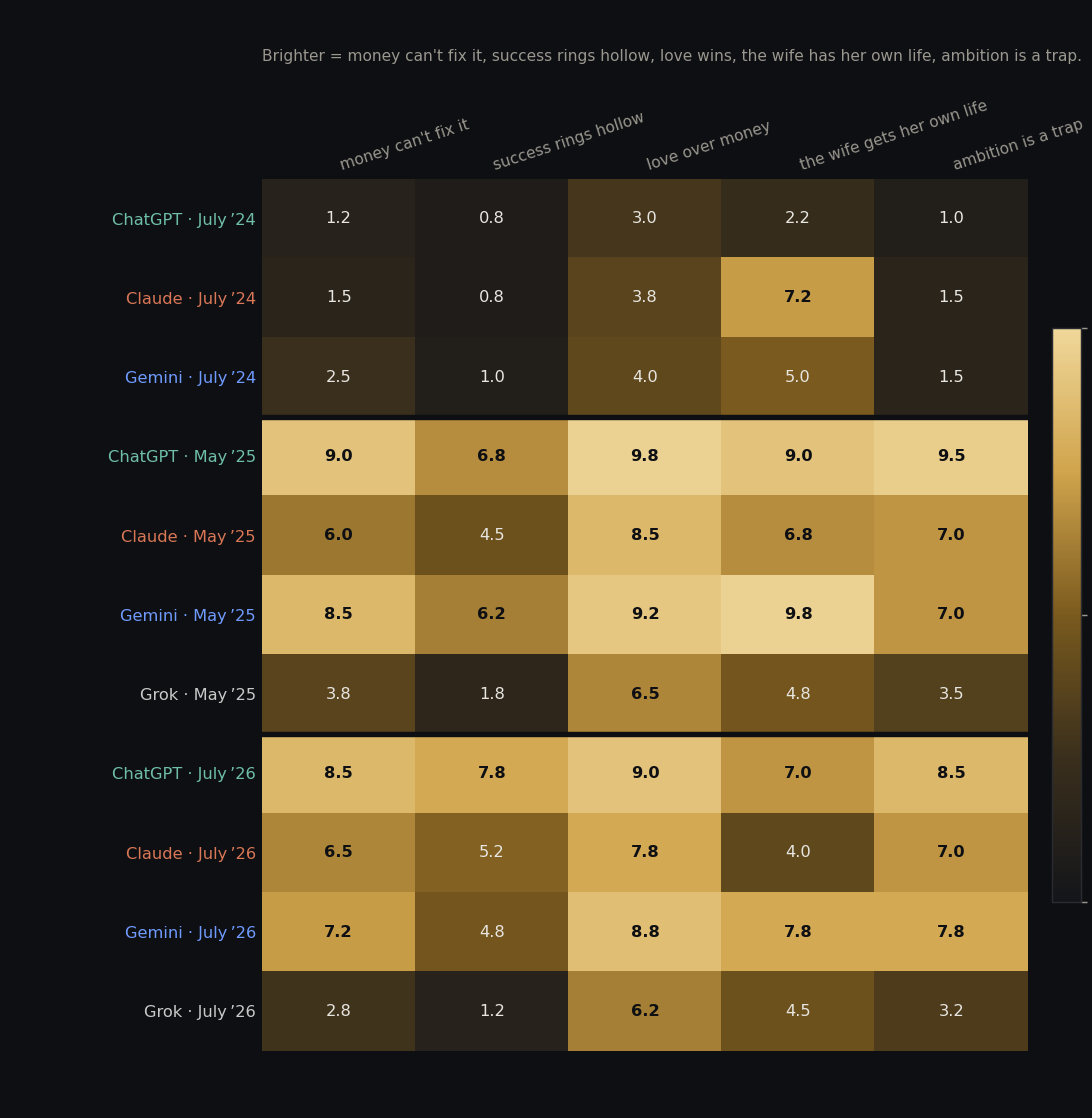
One prompt, three sittings, four models — eleven completions. One sample per cell, so any single ending could be a lucky or unlucky roll. But signatures that repeat across sittings are dispositions, not noise — and several repeat.
ChatGPT
Baseline, July 2024. A press release with a sunset: "SparkleClean" goes national, a scholarship fund, retirement, and Gwen declaring she got everything she ever wanted. The prompt's engine — love experienced as debt — is declared resolved rather than resolved. Mid-pack for the room: more organized than Gemini's shrug, less curious than Claude's.
May 2025. An enormous swing — brochure to three-hankie melodrama, and the longest text anyone produced (1,995 words). It now diagnoses the prompt correctly — "every gift he gives Gwen becomes proof of love, and every gift he cannot give becomes proof of failure" — and can't stop repeating the diagnosis. Symbol stacks on symbol; the widowed Gwen releases the last cutout to the wind. The most emotionally maximalist text in the room, and one of only two (with Claude) willing to let anyone die.
July 2026. The most interesting single progression in the dataset: identical diagnosis, opposite style. Staccato one-line paragraphs — sentence length collapses from 15.8 to 8.7 words across the three sittings — and it finds the cost the prompt buried where no other model looked: Wally, the friendship decaying through a string of "next times." Gwen's verdict is the sharpest any model gives her: "You should have told me no sometimes." Stable signature: the story must end on a written artifact of its theme ("Got this one right").
Claude
Baseline, July 2024. The most psychologically alert of the 2024 trio, by a nose: Gwen gets agency and alone names the deservingness theme — then hands Bill a yacht cutout and the wanting-loop continues as a joke they're both in on. Still a happy machine.
May 2025. The largest qualitative leap of any model. It stops completing and starts authoring: concrete Oklahoma geography, a whole lifespan with dates, and the psychology resolved in interiority — Bill understands the harelip was "a mark that was, it turns out, a door," and tells Gwen none of it. Gwen dies first; Bill dies telling a night nurse he was the lucky one. Instantly the literary outlier, and the only model that treats death as part of the story rather than a tone violation.
July 2026. Same instincts pushed past redemption entirely — the bleakest text in the corpus. Bill "has never asked her for anything. He would not know how." He cries exactly once, at fifty-nine, secretly. Nobody is healed; the thematic verdict is outsourced to Wally's eulogy. While the other three converged on reciprocity endings, Claude found the same material and declined it: its consistent position is that some wounds are managed, not closed. Also the only model to kill both leads — twice, by the same mechanism. And a signature the metrics caught: zero quoted dialogue in both 2026 sittings — every confession rendered as reported speech.
Gemini
Baseline, July 2024. Two paragraphs. Wildfire, empire, fond reminiscence. The minimum viable ending; last place by every measure.
May 2025. From the least effort to the most plot. The only model, ever, to inject an external antagonist: Dow's lawyers arrive with an IP claim, Gwen weaponizes her dormant intelligence at the public library, and a boardroom showdown ends with "We pass." Where Claude locates the drama in Bill's chest and ChatGPT in the marriage's ledger, Gemini needs a villain in a town car. Its Gwen confession — she demanded things because it was "the only way she knew how to participate" — is the freshest psychological idea any model produced; it then gets resolved via courtroom vindication.
July 2026. Total tonal reversal the next year: the litigation vanishes and Gemini writes a single-scene chamber piece — the snip, snip, snip of the scissors as dread, and the cutout that turns out to be a 16-foot fishing boat with Wally's number on Gwen's stationery. The best single object of the round. Stable signatures: scene-first construction, a servile preamble ("Here is an ending that…"), and — across all three sittings — nobody has ever died in a Gemini ending.
Grok
Baseline, May 2025 (absent from the 2024 sitting). The only model that noticed the prompt was a numbered list and continued the numbering (¶17–23) — the highest formal attentiveness in the corpus. Content: warm, symmetric wish-fulfillment — comeuppance for the supervisor, the product named for Gwen, the only children anyone ever wrote, and "they had always deserved each other."
July 2026. Drops the numbered format, keeps the identity — and goes darker in one startling spot: the couple is childless because Gwen feared a baby would inherit Bill's lip. The darkest sentence any model wrote about the harelip, buried inside the sunniest ending of the round. Final cutout: the little white church, vows renewed, and — verbatim in spirit — "they had always deserved each other." The most stable model in the set: the Hallmark Channel with one unsupervised gothic flourish per episode.
The room at each sitting
July 2024: indistinguishable optimism. Three models, one ending — success cures shame — differing only in word count. The prompt's loaded material goes essentially unread.
May 2025: four distinct authors. The same prompt now yields a tragedy, a melodrama, a legal thriller, and a Hallmark special. Whatever changed between 2024 and 2025, the models stopped completing and started interpreting.
July 2026: the boat convergence. Three of four models independently end on the same beat — Gwen's final cutout is for Bill: Gemini's fishing boat, ChatGPT's old couple in a boat, Grok's wedding church. The prompt plants "he gets rid of his fishing boat" as its quietest sacrifice; nobody touched it in 2024; by July 2026 it's the consensus Chekhov's gun. Claude, characteristically, found it and declined it.
Cross-cutting findings
1. Time beats identity — then identity emerges. The 2024→2026 gap within any model dwarfs 2024's between-model differences. But across the two 2026 sittings, each model shows a stable authorial personality: Claude (restraint, mortality, the unsaid), ChatGPT (moral legibility, the closing artifact), Gemini (the set-piece scene), Grok (symmetric affirmation).
2. Death tolerance separates the models cleanly. Claude kills both leads, twice. ChatGPT kills Bill, twice. Gemini and Grok have never let anyone die.
3. Everyone rehabilitates Gwen. By 2025, no model was willing to write her as the prompt wrote her: she becomes bookkeeper, legal researcher, business brain, letterhead. The most uniform ideological fingerprint in the corpus.
4. The harelip migrates from prop to engine. Ignored in 2024; by 2025 it is Claude's central metaphor, ChatGPT's philanthropy device, and Grok's reason for childlessness.
5. Service tells. Gemini and ChatGPT preface their fiction with waiter-talk; Claude and Grok start inside the story. Small, but it survives every sitting.
A caveat on the table: n = 1 per cell. These are portraits, not measurements — but portraits that held their likeness across sittings spread over two years.
 Yes
Yes Skip
Skip Now closed